Panda Specimens in Major American Museums, 1919-1942
Item
-
Title
-
Panda Specimens in Major American Museums, 1919-1942
-
Description
-
Between 1919 and 1942, the three largest American natural history museums acquired 55 specimens of panda skins, skeletons, and skulls from sponsored expeditions and private donations.
-
Commentary
-
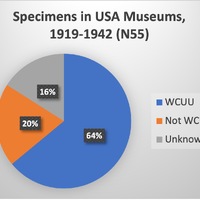
In a race to acquire rare specimens, the American Museum of Natural History (AMNH) in New York, the Field Museum of Natural History (FMNH) in Chicago, and the Smithsonian’s National Museum of Natural History (NMNH) in Washington commissioned or purchased panda specimens of skins, skeletons, skulls, or a combination of all three. American museums acquired 55 specimens before the founding of the People’s Republic of China in 1949, 50 of them before 1934, and the other five apparently the remains of captive live pandas. The Guomindang government banned the capture and export of pandas in 1939.
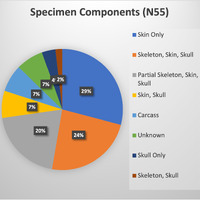
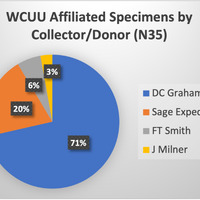
The pie charts associated with this record are based on analysis of the panda specimen holdings of the AMNH, FMNH and AMNH downloaded from these museums’ websites in excel spreadsheets.
Once in American museums, complete specimens with all components could be and were taxidermied and mounted in dioramas or other forms of exhibit. However, only about a quarter of all specimens were complete and suitable for mounting. These included the dead bodies of pandas who had been captured live and kept in American zoos, such as the famous Su-lin at Chicago.
A remarkable 64% (n.35) of these specimens had sojourned at the West China Union University (WCUU) campus in Chengdu, or were obtained by WCUU affiliated missionaries, before making their way to America. Of these 35, 71% (n.26) were obtained by David Crockett Graham on his many natural history collecting expeditions sponsored by the Smithsonian (NMNH).
-
Event Date
-
1919-1941
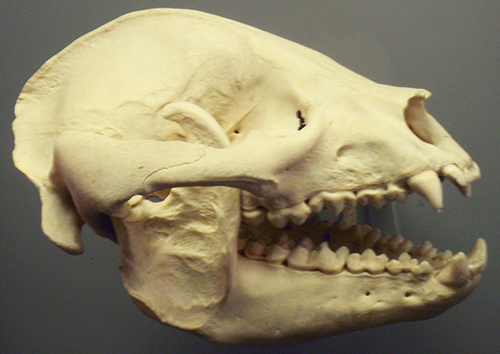
 Table of Live Pandas, 1936-1953
 Panda Specimens by Components, 1919-1941
 Panda Specimens in USA Museums, 1919-1942
 WCUU Affiliated Panda Specimens, 1919-1942