-
 Pandora: From Sichuan to the World’s Fair
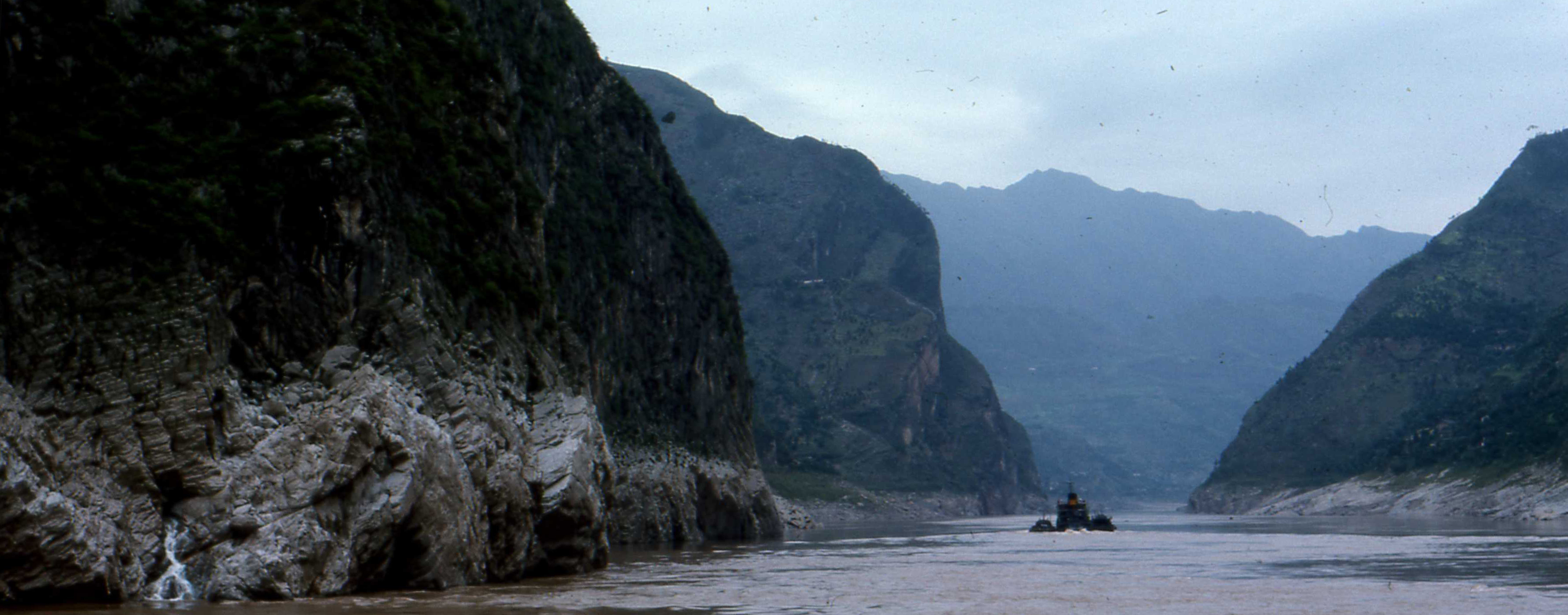
 This event tells the story of Pandora’s journey from Chengdu to New York in May and June of 1938, arriving in time to be on exhibit in the Zoological Society’s pavilion at the World’s Fair.
-
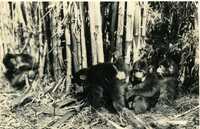 A Group of Rhesus Macaque Monkeys
 A group of M. m. lasiota, the west Chinese rhesus macaque, found in western Sichuan and northern Yunnan, sitting among a stand of bamboo.
-
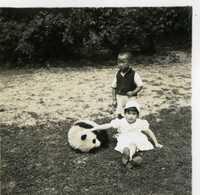 Two Small Children with Pandora
 Two small children - a missionary girl and a Chinese boy - are playing with Pandora on a lawn. The girl has her hand on Pandora who is lying down facing her.
-
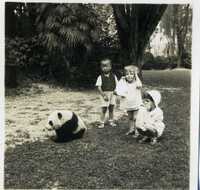 Three Small Children with Pandora 2
 Three small children - two missionary girls and one Chinese boy - playing with Pandora, who is sitting on the lawn in front of them. One of the girls is squatting. Another has taken off her hat. Pandora is paying them no mind.
-
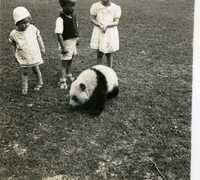 Three Small Children with Pandora 1
 Three small children - two missionary girls and one Chinese boy - stand around Pandora, who appears to be walking on all fours on a lawn.
-
 A Woman and Three Small Children with Pandora
 A young woman crouches over Pandora with three small children watching. The oldest child, a girl, is seated on the grass holding a stick that is in Pandora's mouth. One of the children is a Chinese boy.
-
 Three Children with Pandora - 3
 Three children play with Pandora the panda on a lawn at the WCUU campus. Eleanor (left) and Anne (middle) Williams are petting Pandora. David Spooner kneels to the right of Pandora.
-
 Three Children with Pandora - 2
 Three children play with Pandora the panda on a lawn at the WCUU campus. Eleanor Williams and David Spooner are to the left and right of Pandora, respectively. Anne Williams is holding Pandora in the center.
-
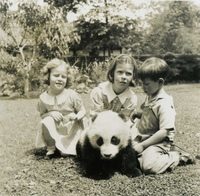 Three Children with Pandora - 1
 Three children play with Pandora the panda on a lawn at the WCUU campus. They are seated on the grass behind Pandora.
-
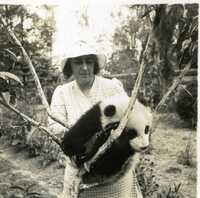 Woman Standing Behind Pandora in Tree
 Woman with hat standing behind Pandora, who is sitting in the crotch of a small tree on the WCUU campus.
-
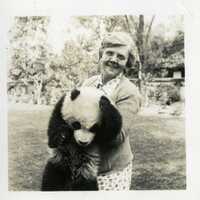 Woman Holding Pandora
 A smiling missionary woman with glasses holding Pandora. She is standing in a yard on the WCUU campus. The panda is holding its left paw up to its ear.
-
 Pandora the Panda in Chengdu
 This event tells the story of Pandora’s sojourn in Chengdu while learning to eat different food and waiting for travel arrangements to be made for her voyage to New York. She stayed on the WCUU campus for about one month, during which she made many friends.
-
 WCMN The Bandit Chief, 1938
 Travel narrative of Edward Beatty's and Gilbert Vinden's trek from Dujiangyan to just beyond Wolongguan, during which they encountered the baby panda, Pandora, for sale in a small mountain village.
-
 Map of the West China Union University Campus
 This map of WCUU was evidentially created in the 1930s, judging by the buildings that are included. The buildings have been numbered in the order in which they were built, which gives a good idea of the growth pattern of the campus.
Concerning the location where pandas lived on campus, David Crockett Graham is thought to have lived in the Baptist houses at 64,65,66 or 67. Pandora, Pandee and Pandah lived with the Grahams there. The Dickinsons, Agnews and other Canadians lived on "Canadian Row," at numbers 36-44 and 92-97. Pandora, Pan, Lien Ho, Happy, and other of Floyd Tangier Smith's pandas lived there.
-
 Map Detail of Region between Wolongguan and Maoshuizi
 This map continues Beatty's and Vinden's trek on their homeward journey from Wolongguan to Maoshuizi, where they saw the baby Pandora panda. They would have left the Shaotang River (P’i T’iao River) at Huachaodi, crossed over the Niutoushangou (Niu T’eo or Shan Cow’s Head Pass), picked up the Zhonghe River at Maluiping, which they followed to Maoshuizi, where they found Pandora for sale. From Sanjiangxiang (San Chiang Ko), where they stayed the night, they were able to get back to Dujiangyan the next day.
-
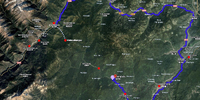 Annotated Map of the Route between Caoping and Wolongguan
 This map's annotations show the key locations mentioned by Beatty in the third and fourth days of his account of his and Gilbert Vinden's trip into tribes country in 1938. Starting at Caoping on the third day, the pair left the riverbed to cross over mountains. They went through Maoshuizi (Mao Shin Tze - the red dot in the middle of the mountains), across the "Cow's Head Pass," and on to Wolongguan by the fourth day.
-
 Annotated Map of the Route between Xuankoucun and Caoping
 This map's annotations show the key locations mentioned by Beatty in the first two days of his account of his and Gilbert Vinden's trip into tribes country in 1938. Starting from Dujiangyan, the pair made it on foot to Caoping in two days. This part of the route follows the Shouxi River all the way. Maoshuizi (Mao Shin Tze), where the pair encountered baby Pandora on their way back is also indicated.
-
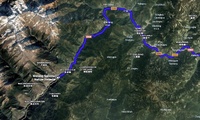 Map Showing Relation of Panda Captures to Panda Reserve
 At least two baby pandas were captured near Wolongguan - Pandora in 1938 and Pandee in 1941. This is where there is a large nature reserve today.
-
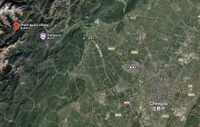 Map of Region between Chengdu and Wolongguan
 Google map showing overview of distances between Chengdu and Dujiangyan, and Dujiangyan to Wolongguan, near where at least two baby pandas were captured - Pandora in 1938 and Pandee in 1941.
-
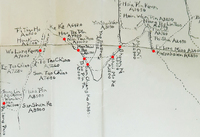 Annotated Segment of Helde's "Part of Western Szechwan"
 This is a small segment of a much larger map produced by George Helde, a YMCA missionary, on trips he took to the western hill country in 1921 and 1922. Helde had just lost his wife in childbirth at Mt. Emei when he set out in 1922. The annotations show locations on the route that Edward Beatty and Gilbert Vinden took on their journey to Mowkung in 1938 when they encountered Pandora the baby panda in Maoshuizi village on their return trip. Beatty and Vinden took the same route that Helde documented in 1920.
-
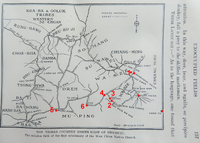 Annotated Map of Tribal Regions in Sichuan's Southwest, 1920
 The map shows tribal territories in Western Sichuan as missionaries understood them before 1920. The portions labelled "Wasze" are where Wassu hunters were successful in capturing live baby pandas for foreign buyers, including David Crockett Graham, Frank Dickinson, Walter Small, Daniel Dye and others.
-
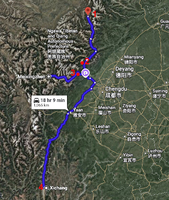 Annotated Google Map of Panda Territory
 This map shows panda territory extending from Songpan in the north to Xichang in the south, with locations indicated were famous pandas Sulin and Pandora were captured.
-
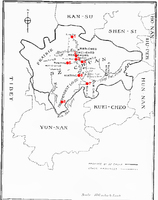 Annotated Map of West China, 1920
 This map of the mission stations in West China in 1920 has been annotated to illustrate key locations in panda hunting territories, which stretch from Songpan in the North to Xichang in the south. Key cities are also included for orientation.
-
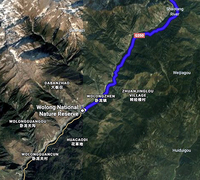 1938 Trip to Wolong and Pandora the Panda
 This event describes and illustrates the journey of Edward Beatty and Gilbert Vinden on the route to “Mao Shin Tze” [Maoshuizi] where Pandora the baby panda was captured in 1938. This town is near Wolongguan where another baby panda, Pandee, was captured in 1941. There is a panda reserve at Wolongguan today.
-
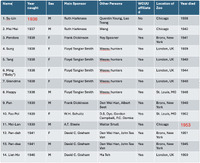 Table of Live Pandas, 1936-1953
 From 1936 to 1946, 14 live baby pandas were captured and sent to zoos in the US and UK. Of these, Mei-Lan lived the longest - almost 15 years at the Brookfield Zoo in Chicago.