-
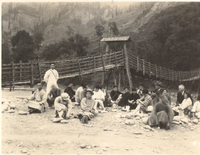 Group Seated at Base of Anlan Bridge
 Four unidentified missionaries are seated on the rocks with a group of Chinese, some of whom appear to be students by their age and dress. One of the missionaries has a pair of binoculars in her lap (very likely Jane Balderston Dye). The group is seated at the base of the bridge on the west bank of the Outer River during low water season. One Chinese man is standing, perhaps a leader of the excursion. In the background can be seen hillsides stripped of lumber.
-
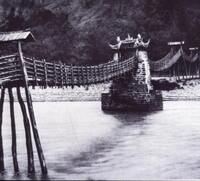 Anlan Rope Bridge at Dujangyan, 1944
 Looking east over the Outer River toward the mountain where Er Lang temple is from the opposite shore. The shoreline in the photo is the artificial island that terminates with the Fishmouth, which is to the left just outside the frame. The Inner River is not seen, but one can see the two pilons that hold the bridge over it.
-
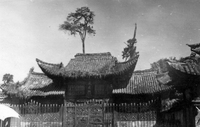 Dujangyan Temple Top Fence
 Probably influenced by Dan Dye's work on lattice (1937), the subject of this photo is the lattice fence. It is not clear which of the Dujangyan temples this is.
-
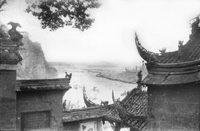 Dujiangyan from Er Wang Temple Overview
 Looking south over the roof of Er Wang Temple and the peak with the Rhinoceros Fighting Pavillion. On the opposite shore (center), one can see the Flying Sand Spillway. The Bottleneck, or Precious Vase Neck, and the Fulong Guan Temple are hidden behind the rock face at left. In the foreground one can see the corners of two of the ancient inscriptions in the temple.
-
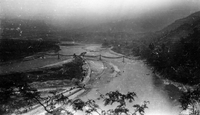 1944 Dujiangyan Panorama 2
 Looking north from Mt. Yulai towards the Anlan Bridge, this panoramic scene shows the location of the dam extending from the tip of the Fishmouth to the eastern shore north of Er Wang Temple, which is barely visible on the mountain slope. Workers are departing the scene as their job is done for the year.
-
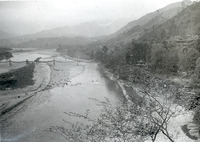 1944 Dujiangyan Panorama 1
 Looking north from Mt. Yulai towards the Anlan Bridge, this panoramic scene shows the location of the dam extending from the tip of the Fishmouth to the eastern shore north of Er Wang Temple, which can be seen in the trees on the mountain slope. The dam has been broken and the water has begun to enter the Inner River.
-
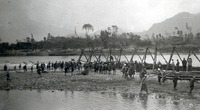 1944 Min Diversion 5
 Looking towards the Western shoreline of the Outer River, we see workmen pulling a rope to tear down the dam. The Fishmouth is to the left out of the frame. There is a sailboat parked on the shore in front of what appears to be a camp of pup tents, perhaps for the workers, but possibly for the US Army, since they were present in the region at that time.
-
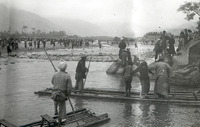 1944 Min Diversion 4
 Close up of action on the eastern shoreline of the Inner River as workers and spectators anticipate the flow of water from the broken dam, which can be seen in the distant center of the scene. In the right foreground, a young woman and boy help balance the raft as a rather stout monk gets on board. His occupation is revealed by his style of robe with billowy sleeves, although he also wears a Western style fedora. Note the woman's natural feet.
-
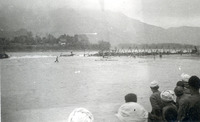 1944 Min Diversion 3
 Overlooking the turban-clad heads of spectators, men on foot and on rafts attend to the opening of the dam across the Inner River. A small corner of the Fishmouth can be seen at far left.
-
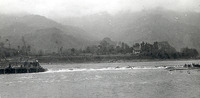 1944 Min Diversion 2
 Looking directly east across the Inner River, the dam opening has grown larger. Spectators watch from the Fishmouth to the left. Workers oversee the dam operation at the right.
-
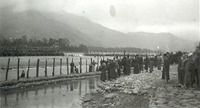 1944 Min Diversion 1
 Standing on the east shore north of Er Wang Temple, looking northwest at the dam, which has just been broken. A large crowd of spectators can be seen standing on the head of the Fishmouth. In the right foreground, another large crowd watches the dam opening, many of them wearing changshan, or scholar's gowns. A temporary weir of stone can also be seen in the foreground running parallel to the eastern shoreline.
-
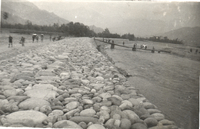 Dujiangyan Pier with Temporary Ramp
 Looking north along an artificial embankment towards workers carrying loads on a temporary bridge over a narrow channel of the Min River. The close up view of the stonework shows the integrity of the craftmanship.
-
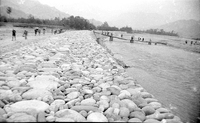 Dujiangyan Embankment with Temporary Ramp
 Looking north along an artificial embankment towards workers carrying loads on a temporary bridge over a narrow channel of the Min River. The close up view of the stonework shows the integrity of the craftmanship.
-
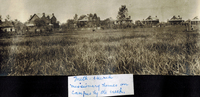 Canadian Row at WCUU from Creek
 This photograh shows the six houses on the outer row of the "Canadian Row," which faced an irrigation ditch or stream, but was later converted into an athletic field. Apparently the Johns' house was not among these houses because they are all of the later style with verandahs encircling bith first and second floors. After a few decades, missionaries learned that those upper verandahs were just what was needed for summer sleeping quarters.
-
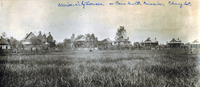 Canadian Row at WCUU Across Field
 This photograh shows the six houses on the outer row of the "Canadian Row," which faced an irrigation ditch or stream, but was later converted into an athletic field. Apparently the Johns' house was not among these houses because they are all of the later style with verandahs encircling bith first and second floors. After a few decades, missionaries learned that those upper verandahs were just what was needed for summer sleeping quarters.
-
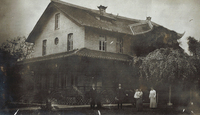 1913 Johns' Home in Chengdu
 Alfred and Myrtle Johns stand on the lawn of their home on "Canadian Row" with another (unidentified) missionary family. The two story house is a mixture of European and Chinese architecture and has a verandah surrounding the first floor.
-
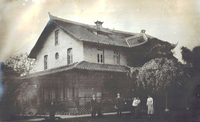 1913 Johns' Home at WCUU
 Alfred and Myrtle Johns stand on the lawn of their home on "Canadian Row" with another (unidentified) missionary family. The two story house is a mixture of European and Chinese architecture and has a verandah surrounding the first floor.
-
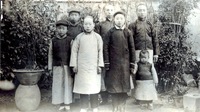 Johns' Language Teacher with His Family
 Johns' language teacher (center back) with his wife (front, second from right) with their family (front) and friends (back, right and left?). Note the men's changshan or "scholars' gowns," and the women's trousers and bound feet.
-
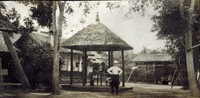 Lao Guan Miao Back View with Alfred Johns
 Alfred Johns wearing pith helmet stanfing inside the courtyard of Lao Guan Miao. Trees, a small gazebo, and other out buildings can be seen within the compound.
-
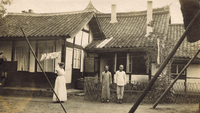 Lao Guan Miao Back View with Myrtle Johns
 Described differently as both back and front of the compound at Lao Guan Miao, it appears to be inside the courtyard. Myrtle Johns stands with a Chinese language instructor and a servant, the former identified by his changshan or "scholars' gown."
-
 Lao Guan Miao Back View
 Described differently as both back and front of the compound at Lao Guan Miao, it appears to be inside the courtyard. Myrtle Johns stands with a Chinese language instructor and a servant, the former identified by his changshan or "scholars' gown."
-
 Lao Guan Miao with Myrtle Johns Reading
 Entrance to a compound of Chinese architecture with modern European updates. Myrtle Johns sits pn a wicker chair near the door, probably studyung Chinese language. A "chair" awaiting a passenger sits behind her.
-
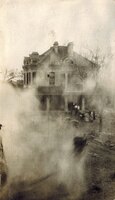 Elson's Farewell Firecrackers
 Smoke from the firecrackers obscures the foregrounf. In the background can be seen an unidentified group of people on the steps of the Elsons' verandah.
-
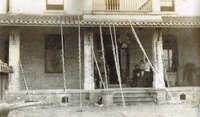 Elson Verandah with Firecrackers
 The Elson verandah with a group of unidentified missionary women and a Chinese soldier with his back turned. Long sticks with firecrackers lean up against the porch awaiting the moment to launch the send off salute.
-
 Endicott House at WCUU, c1910
 Large brick house of mixed European and Chinese architecture with first and second story verandahs and vines growing on the brick.