-
Title
-
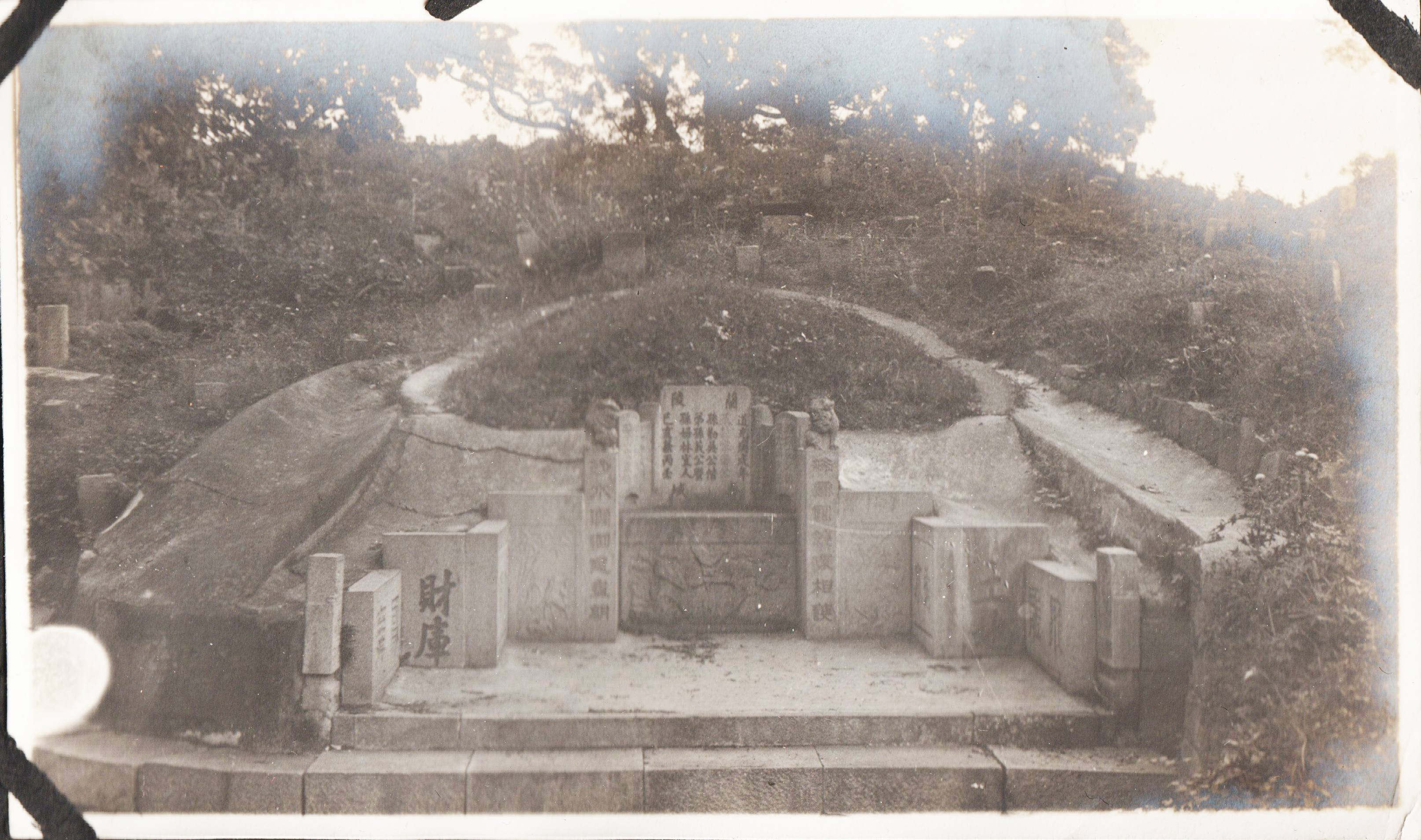
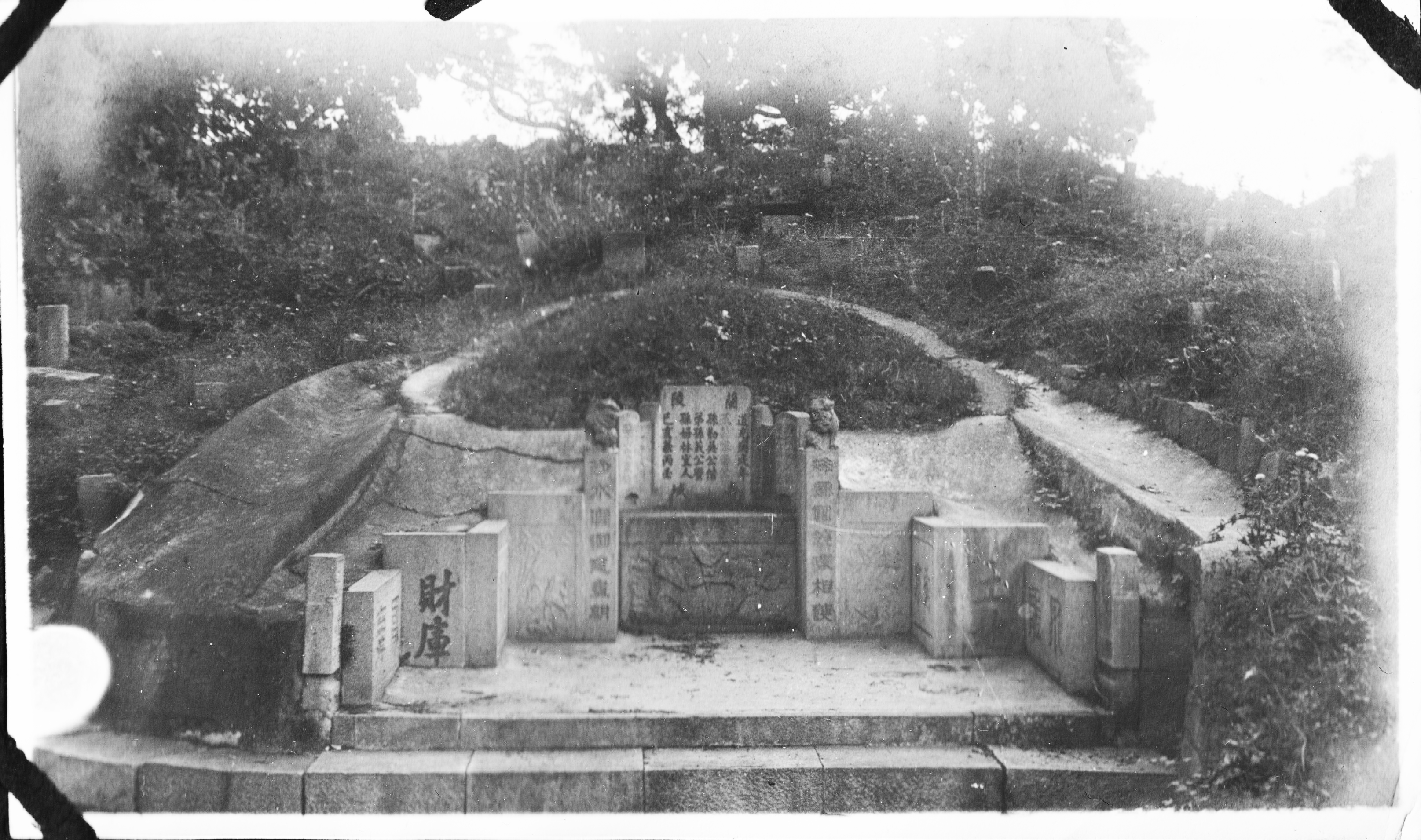
Chinese Mausoleum on a Hillside
-
Caption
-
Unidentified Chinese Tomb
-
Identifier
-
SEFA_048
-
Alternative Identifier
-
Simpson Album p9
-
Description
-
The gravesite of a wealthy Chinese family is a stone semi-circle with two pillars topped by a pair of lions in the center. These pillars, representing Heaven's Gate, flank an engraved stone plaque. A trough around the outer rim appears to protect the grave from water damage. In the background are Western-style gravestones on a grassy hillside.
-
Commentary
-
During the 1911-1912 evacuation, Alice Estabrook took classes for a year or so at a mission school for training teachers in Fuzhou, Fujian.
-
Date Created
-
1911-1912
-
Location
-
Fuzhou, Fujian
-
Original Format
-
Photographic print
-
Translation
-
Reading right to left, top to bottom, with the □ character standing in for illegible characters:
Top of the central stone: 蘭陵 (Lanling, the traditional ancestral origin of the Xiao 蕭 family; from this, I infer that this was a Xiao family grave)
Column 1: 道光庚戌年 (the 30th year of the Daoguang reign, 1850)
Column 2: too faint to read
Column 3: 孫勤□公偕 (the esteemed late grandson Mr. Qin□, together with…; the third character may be 萬 or 黃)
Column 4: □孫□公□ (another esteemed late grandson; the third character has the "grass" radical 艹 at the top, possibly 葳)
Column 5: 孫婦林宜人 (Lady Lin, the grandson's wife; Lin is her maiden name, and yiren was an honorary title granted by the court to the wife of a fifth-rank official)
Column 6: 巳亥兼丙壬 (the grave's exact orientation according to the feng shui master's compass)
Bottom of the stone: 佳城 (the first character is inferred; literally "a fine city," a classical poetic description of where the dead dwell peacefully in the other world)
Small stone block at the front left: 財庫 (literally "storehouse of wealth," asking the ancestors to bless their descendants with prosperity)
-
Translator
-
Qingyi Zhang, The Hong Kong Polytechnic University
-
Hsianghui Liu-Spencer, Laurence McKinley Gould Library, Carleton College
-
Source
-
Courtesy of Kyle Jolliffe
-
Provenance
-
E. Kyle Simpson photos curated by Alice Estabrook Simpson - captions written by her. In the care of Kyle Jolliffe.
-
Publisher
-
SIUE
-
Record Date
-
2026-09-28
-
Contributor
-
Cory Willmott; Kyle Jolliffe; Qingyi Zhang; Hsianghui Liu-Spencer
-
Type
-
Still Image
-
References
-
Nan Qi shu 南齊書 (Book of Southern Qi), juan 1, "Annals of Emperor Gao." Beijing: Zhonghua Shuju, 1972. Xiao Daocheng, founder of the Southern Qi dynasty, is recorded as 「姓蕭氏……南蘭陵蘭陵人也」, "of the Xiao surname… a native of Lanling, in Southern Lanling." (Families from Lanling who moved south kept their home name, with "Southern" added.)
-
Liang shu 梁書 (Book of Liang), juan 1, "Annals of Emperor Wu." Beijing: Zhonghua Shuju, 1973. Xiao Yan, founder of the Liang dynasty, is recorded as 「南蘭陵中都里人」, "a native of Zhongdu village, Southern Lanling."
-
Qing shi gao 清史稿 (Draft History of the Qing), juan 110, "Treatise on Selection 5." Beijing: Zhonghua Shuju, 1976–1977. Among the titles for officials' wives: 「正、從五品宜人」, "for the fifth rank (upper and lower grades): yiren."
-
Xijing zaji 西京雜記 (Miscellaneous Records of the Western Capital), juan 4, "The Burial Site of Lord Teng." When a grave was being dug for Lord Teng (Xiahou Ying, a Han dynasty official), a stone chamber was found bearing the inscription 「佳城鬱鬱,三千年見白日。吁嗟滕公居此室」, "The fine city lies in darkness; after three thousand years it sees the light of day. Alas, Lord Teng will dwell in this chamber." From this story, 佳城 became a classical term for a tomb. (The story is also collected in Taiping guangji 太平廣記, juan 391.)
-
Chen Weihua 陳緯華, "Cong mubei lai kan 'tuzhuhua' xianxiang: Qingdai yilai Taiwan shehui zuji rentong de bianhua" 從墓碑來看「土著化」現象:清代以來臺灣社會祖籍認同的變化 (Gravestones and "indigenization": changes in ancestral-origin identity in Taiwanese society since the Qing), Minsu quyi 民俗曲藝 197 (2017): 185–231. This study discusses the Han Chinese custom of carving the family's junwang or ancestral place name on the top band of the gravestone.
-
Luo Yongchang 羅永昌, "Qingdai zhi Rizhi shiqi Miaoli xian Gongguan xiang gumu zhi tianye tacha" 清代至日治時期苗栗縣公館鄉古墓之田野踏查 (A field survey of old graves in Gongguan, Miaoli, Taiwan, from the Qing to the Japanese colonial period), Taiwan wenxian 臺灣文獻 75, no. 3 (2024): 219ff. Qing-era gravestones in this survey use 佳城 for the grave, e.g., 「顯妣諡勤助劉母邱孺人佳城」 (1878).

 Simpson-Estabrook Photo Album