-
Title
-
Pandora the Panda in Chengdu
-
Description
-
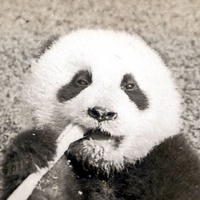
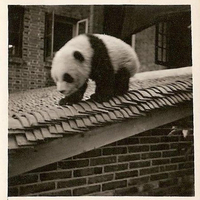
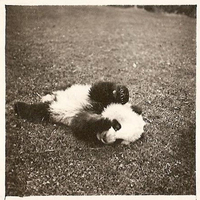
This event tells the story of Pandora’s sojourn in Chengdu while learning to eat different food and waiting for travel arrangements to be made for her voyage to New York. She stayed on the WCUU campus for about one month, during which she made many friends.
-
Commentary
-
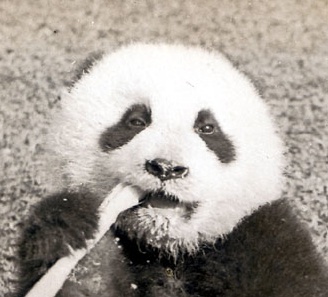
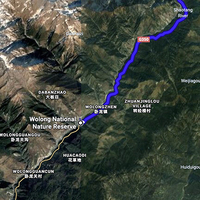
The baby giant panda, Pandora, arrived in Chengdu in mid-April 1938, after being purchased by Den Weihan for Frank Dickinson in Maoshuizi near Wolongguan (1 and 2). She was between 30 and 35 pounds on arrival, the second smallest panda cub next to Su-Lin ever to pass through WCUU (3). At first, she refused to eat. So, David Crockett Graham kept her for a week or two on his screen porch as he taught her to eat the way he learned from Ruth Harkness when she visited WCUU with Mei-Mei on January 2, 1938 (1 and 4). Pandora was still “on the bottle,” so Graham got Pandora started on a diet of orange juice and milk (5 and 6).
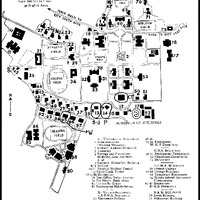
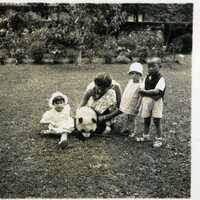
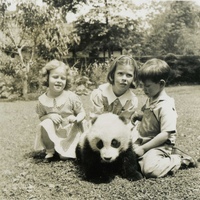
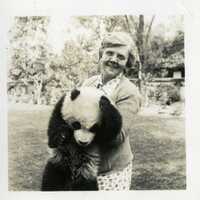
Graham lived at the northwest extremity of the WCUU campus in new housing built for American Baptist missionaries. While Pandora was with them, Graham’s wife Alicia and daughter Jean formed a strong bond with Pandora. On a snapshot of her with Pandora, Alicia wrote that she wanted to keep her “cunning pet.” When the Graham family visited Pandora at the New York World’s Fair a few years later, her sister Margaret wrote, “As Jean put it, ‘It burns her up to pay a quarter to see her own panda” (7). One suspects that Alicia and Jean did their share in feeding Pandora her bottle!
After Pandora’s feeding stabilized, Graham turned her over to Frank Dickinson who lived all the way over on the other side of campus in “Canadian Row” (1). Pandora moved into the Dickinson yard with four other pandas whom Floyd Tangier Smith had caught. Here the houses were tightly packed in two rows, allowing much socializing among the families and pandas living there. As Pandora grew, she would have to diversify her native diet of bamboo, which was scarce in North America. At the Dickinsons, missionaries experimented with her diet by introducing “scientific” food types. Some staples that she enjoyed were corn syrup, ground corn, pablum and KLIM (a brand of powdered milk), with bamboo and sugar cane to cut her teeth (8). Scientists were later to learn that these foods were not good for pandas’ digestive systems.
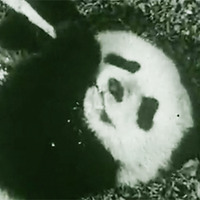
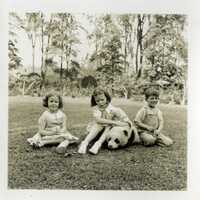
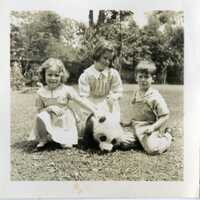
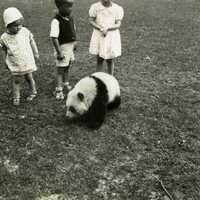
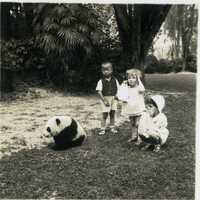
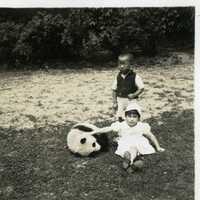
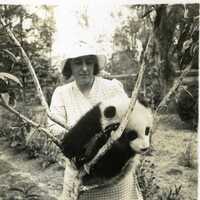
During this period, many children and adults had their photos take while they played with Pandora. When Pandora was living among the American Baptists, Alicia Morey Graham, Jean Graham and Anne Kennard were photographed with her. When she moved to the Dickinsons’ in Canadian Row, many more people were photographed with her. The Mulletts, Walmsleys, Spooners, Willmotts and others all took series of photos of and with the pandas. One day, the Chinese filmmaker Sun Minling, who was making a documentary about the newly founded province of Sikang (between Sichuan and Tibet), took film footage of Pandora, the first known moving picture of a panda (9 and 10).
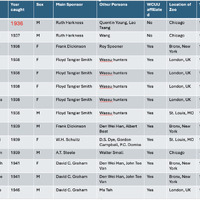
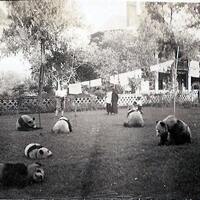
Floyd Tangier Smith’s pandas were larger than Pandora and not as friendly. He kept them in cages and tied to stakes in the hot sun. One of them bit Dr. Agnew’s daughter when she poked it with a stick, after which the missionary children were not allowed to visit Smith’s pandas (11). He was forced to give one of them to the GMD government zoo in Chongqing, foreshadowing the government crackdown on the capture and export of pandas in the summer of 1939 (12).
In the spring of 1939, however, Den Weihan caught another panda for Frank Dickinson and the Bronx Zoo (1). First called “Bimbo,” and later “Pan,” this panda’s personality was opposite to that of Pandora. He displayed aggression towards humans and was disinterested in entertaining for them (13). No more lovable panda pets were to play with missionary children until 1941, when Den Weihan and David Crockett Graham caught two baby pandas that Mme. Chiang Kaishek had ordered to replace Pandora and Pan, who had died at the Bronx Zoo.
-
Event Date
-
1938-04-20 to 1938-05-17
-
References
-
1. David Crockett Graham. “How the Baby Pandas Were Captured.” Animal Kingdom 45, no. 1 (1942): 19-23.
-
2. David Crockett Graham (Chengdu), to John Tee Van (Chicago), Nov. 30, 1941.
-
https://www.davidcrockettgraham.org/dcgraham/digital-repository
-
3. Desmond and Ramona Morris. Men and Pandas. McGraw-Hill, 1966, p. 211.
-
4. “Diaries, DCG-1937-01-01-to-1939-03-24-Diary-mjh.pdf.”
-
https://www.davidcrockettgraham.org/dcgraham/digital-repository
-
5. Ed Peltret. “Marine News.” San Francisco Chronicle June 8, 1938, p. 27.
-
6. "Rare Panda Arrives by Plane: Baby Specimen for New York Zoo." Hong Kong Daily Press, May 20, 1938, p. 1.
-
https://archive.org/details/NPDP19380520/page/n1/mode/2up?q=panda
-
7. “Letters, DCG-1941-10-19-MJGtoMJG-cgh.”
-
https://www.davidcrockettgraham.org/dcgraham/digital-repository
-
8. Roy Spooner. “Death of Pandora.” West China Missionary News 43, no. 11 (1941): 276.
-
9. CCTV. "The Traveler with the Camera" (dai sheyingji de lvren) in the series, “Long Shots of the Century” (shiji chang jingtou), 3:16 – 3:43.
-
https://tv.cctv.com/2010/06/08/VIDE1355584564057278.shtml?spm=C55924871139.PY8jbb3G6NT9.0.0
-
10. Girling, Alison. 2015. “Pandora the Panda Bear,” Vic in China
-
https://library.vicu.utoronto.ca/exhibitions/vic_in_china/sections/life_in_west_china/pandora_the_panda_bear.html
-
11. Foster Stockwell. Westerners in China: A History of Exploration and Trade, Ancient Times through the Present. McFarland & Company, 2003.
-
12. Ernest Hibbard (Chengdu) to J. H. Arnup (Toronto), May 17, 1938 (UCCA 1983.047C 7-145).
-
13. Albert Best. “That Panda Story: A Letter.” West China Missionary News 41 no. 11 (Nov. 1939): 439-441.
 Pandora_Headshot.jpg
 1938 Trip to Wolong and Pandora the Panda
 1941 Graham's Giant Panda Hunt
 Pandora: From Sichuan to the World’s Fair
 A Woman and Three Small Children with Pandora
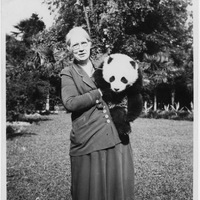 Alicia Morey Graham with Baby Panda
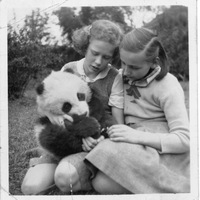 Jean Graham and Anne Kennard with Baby Panda
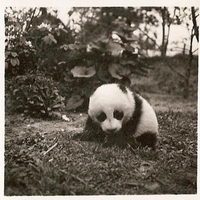 Pandora Crawling on a Lawn
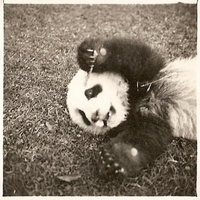 Pandora Holding a Small Stick
 Pandora on a Tile Roof
 Pandora Rolling on the Grass
 Six of Floyd Tangier Smith's Pandas
 Three Children with Pandora - 1
 Three Children with Pandora - 2
 Three Children with Pandora - 3
 Three Small Children with Pandora 1
 Three Small Children with Pandora 2
 Two Small Children with Pandora
 Woman Holding Pandora
 Woman Standing Behind Pandora in Tree