-
Title
-
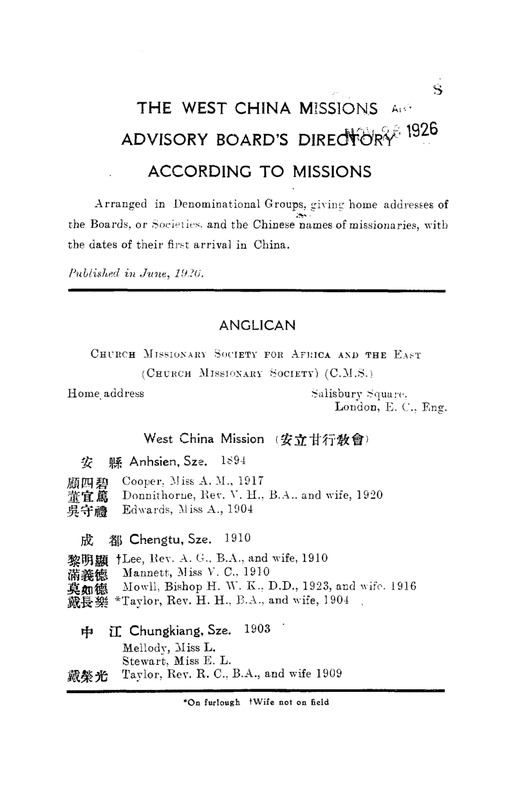
The West China Missions Advisory Board’s Directory 1926, According to Missions
-
Identifier
-
WCMN_0001
-
Description
-
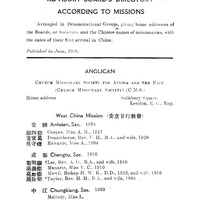
Subtitle: "Arranged in Denominational Groups, giving home addresses of the Boards, or Societies, and the Chinese names of missionaries, with the dates of their first arrival in China." Document also contains list arranged alphabetically.
-
Commentary
-
The West China Missions Advisory Board (WCMAB) compiled a list of missionaries in West China annually. Each denomination was responsible for compiling their own statistics and forwarding them to the advisory board member in charge of statistics. For this reason, the stats compiled for the different denominations are not uniform. For example, the Friends Foreign Mission included the names of missionary wives, while none of the others did. Some denominations included the higher education degrees that wives obtained, while other didn't.
Nevertheless, the advisory board lists are invaluable data about who was stationed where, when, and by whom. The summer of 1926 was the heyday of missionary activity in West China before the Nationalist Revolution of 1926 to 1927 when all the missionaries had to evacuate for a period of six months to a year, and many did not return. It is also the year that the Canadian Methodists, Presbyterians, and Congregationalists joined together to create the United Church of Canada, thereby consolidating their West China mission under one umbrella. It is therefore the ideal year to gain a snapshot of missionary statistics.
The goal of this analysis is to help identify the traits of a cohort of West China missionaries who had similar experiences before, during and after their lives as missionaries. Members of the cohort were descendants of rural Anglophone settlers in North America. Born between the 1850s and 1920s, cohort members were linked through social networks within the organizations to which they belonged. The Methodist and Baptist denominations in North America worked closely with the YM/WCA and other parachurch organizations to funnel promising youth into mission work. These common backgrounds tended to produce similar theological leanings within the broad umbrella of the social gospel, although there were also subtle differences in perspectives and approaches among them.
Non-cohort missionaries came from different national and institutional backgrounds, and they often had different theological points of view as a result. The China Inland Mission (CIM), for example, recruited missionaries from the British Empire, including England, Australia, New Zealand and Canada. The largest mission outside the Methodists, CIM was structured much differently than the cohort missions, receiving no salaries or support from home mission boards. CIM missionaries also leaned much farther right theologically. In West China, CIM missionaries tended to be stationed either in a series of mission hostels on the route to West China, or in remote regions where they focused mainly on evangelism.
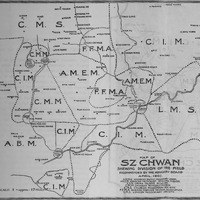
The CIM example highlights how missionary geography in Sichuan also played a role in demarcating the cohort, as the station locations for each denomination remained very similar to the way the WCMAB carved up the map of “fields” in 1902 (see related map below). A major change came when CMM took over the territory formerly assigned to the London Missionary Society (LMS) in 1910. Although seeming peripheral on the map, the western corridor along the Min River from Chengdu to Yibin (Suifu) became a major focus of missionary activity, as well as where many of their summer resorts were located. Those denominations on the northern, eastern and southern perimeters remained marginal to the cohort that became established in the central areas.
Analysis of this dataset of 607 total individuals stationed in Sichuan is presented in a series of bar and pie charts linked to this record. This dataset focuses on percentages of missionaries along lines of nationality, denomination, gender and education. By analyzing these variables, we can clearly see the subset of missionaries who are in the cohort as distinct from those who are not. Except for gender, each of these variables sets the two groups apart.
Those stationed in Yunnan and Guizhou have been omitted from the 1926 WCMAB analysis. Their inclusion would not make a significant difference to the results because the numbers are small and, if anything, would strengthen the demarcation made between cohort and non-cohort missionaries. These charts focus on percentages of missionaries along lines of nationality, denomination, geography, gender and education. By analyzing these variables, we can clearly see the subset of missionaries who are in a cohort as distinct from those who are not. With the exception of gender, each of these variables sets the two groups apart.
-
Creator
-
West China Missions Advisory Board
-
Date Created
-
June 1926
-
Is Part Of
-
WCMN 28(7)
-
Record Date
-
2024-11-06
-
Contributor
-
Cory Willmott
-
Type
-
Dataset
-
Published In
-
Supplement, West China Missionary News 28(7): 1-28

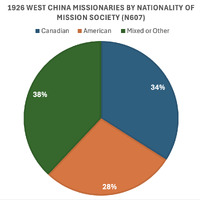 1926 Sichuan Missionaries' Nationalities
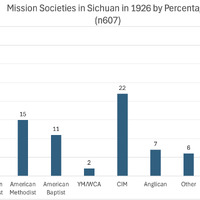 1926 Denominations of all Missionaries in Sichuan
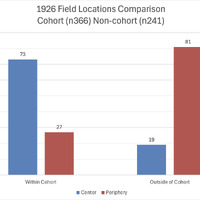 1926 Field Locations of all Missionaries in Sichuan
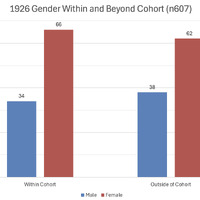 1926 Gender & Marriage Status of North American Missionaries in Sichuan
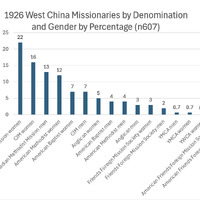 1926 Denomination and Gender of All Missionaries in Sichuan
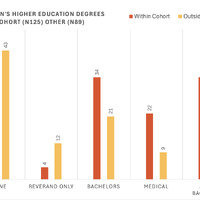 1926 Sichuan Men's Higher Education Degrees
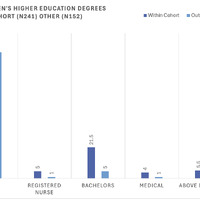 1926 Sichuan Women's Higher Education Degrees
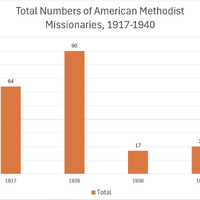 American Methodist Episcopal West China Missionary Attrition
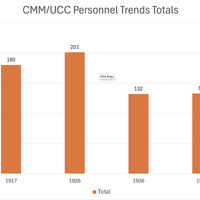 Canadian West China Missions’ Personnel Trends
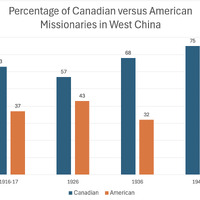 Percentage of Canadian versus American Missionaries in West China, 1916/17 - 1940/41
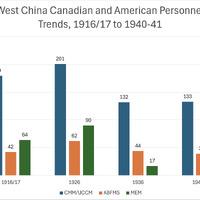 West China Mission Personnel Trends, 1916/17 - 1940/41