Ch 4-2: Air Travel Comes to West China
The warlord Liu Xiang was a pioneer in bringing air service to Sichuan. In 1928-1929, he oversaw the conversion of a military base into an airport at Liangshan, about 120 miles northeast of Chongqing City. This airport is currently called Liangping Airport (梁平机场). Two years later, Liu Xiang also constructed the first airport near Chengdu, Fenghuangshan Airport (成都凤凰山机场), about 15 miles northwest of Chengdu. These airports literally paved the way for air mail and travel into and out of Sichuan.
Gerald Bell of the United Church of Canada mission in Chengdu, reported to Jesse Arnup and Jim Endicott Sr. in Toronto on June 6th 1933 that the first air mail plane arrived in Chengdu. Geraldine Hartwell (UCCA “News letter of March and April, 1933,” 4) of the WMS described the scene:
June 1st the airmail arrived and then what excitement!!! The aeroplane came about 11:30 am and flew around several times to see just where to land as this was the first time landing in the city. I never saw people collect so fast. The wall a block away was simply black with people in a few minutes. Such a commotion all day. The whole city came it seemed. The crush of rickshaws and people on our streets here made it impossible to walk. The plane landed on the East Parade ground which is just beside the Press at the end of our street. A little girl was pushed down the wall on the street just outside our door and drowned. It came back on the 4th and stayed three days and the people have been streaming to see it, so that all the street sellers and fortune tellers and beggars have come to make it like the Spring Fair.
Air mail had become regular by Aug. 12th, 1935. This made a huge difference in missionaries’ private lives and official mission business. On April 2, 1936, Bell reported the first air travel service coming to Chengdu from Chongqing (UCCA 1983.047C 4-87, 5-111, 6-122).
American Baptist missionary Mrs. Anna Salquist (1937, 109-110) reported in 1937 how the introduction of airplanes had improved long distance communications in Chengdu, and indeed throughout the Chinese nation:
Having come to China thirty-five years ago and known the old China, it often seems to me an impossible dream that I now hear the airplane overhead several times a week and can get a letter from Shanghai in a day instead of several weeks, and too, that I am writing within sight of our new broadcasting station. When I arrived in China there was only one post office in this huge province and that but newly established in Chungking. Now it is possible to mail a letter in most towns. Transportation facilities are gradually improving and as closer contacts between the people in the different provinces become possible, there will be greater unity of spirit and better cooperation than there was when each section lived largely unto itself. I still have hope of seeing a truly unified China before my time of retirement from active service.
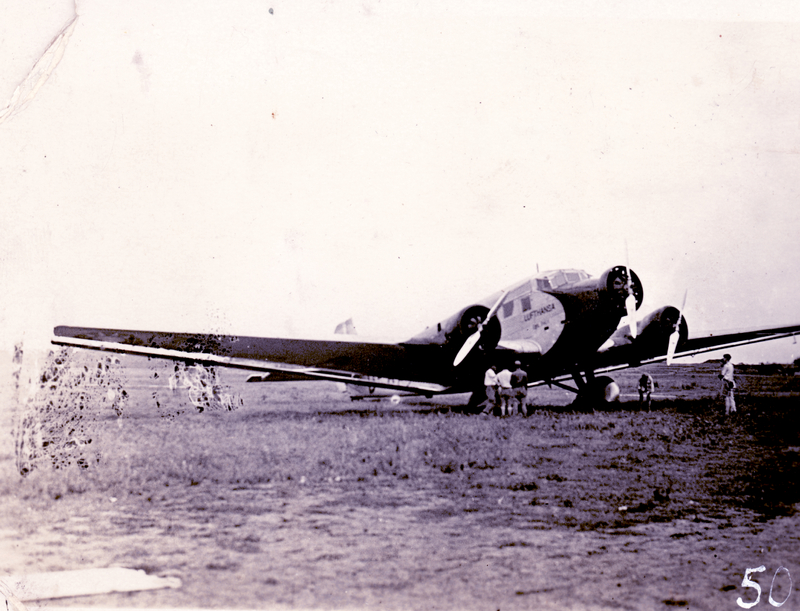
Before the war, German and American planes could be seen on the Fenghuangshan Airfield. Chiang Kai Shek had obtained a German Tri-Motor “Junkers,” on which he gave a ride to the Canadian School in West China’s graduating class of 1935, an experience that is still recalled today (Willmott 2022).
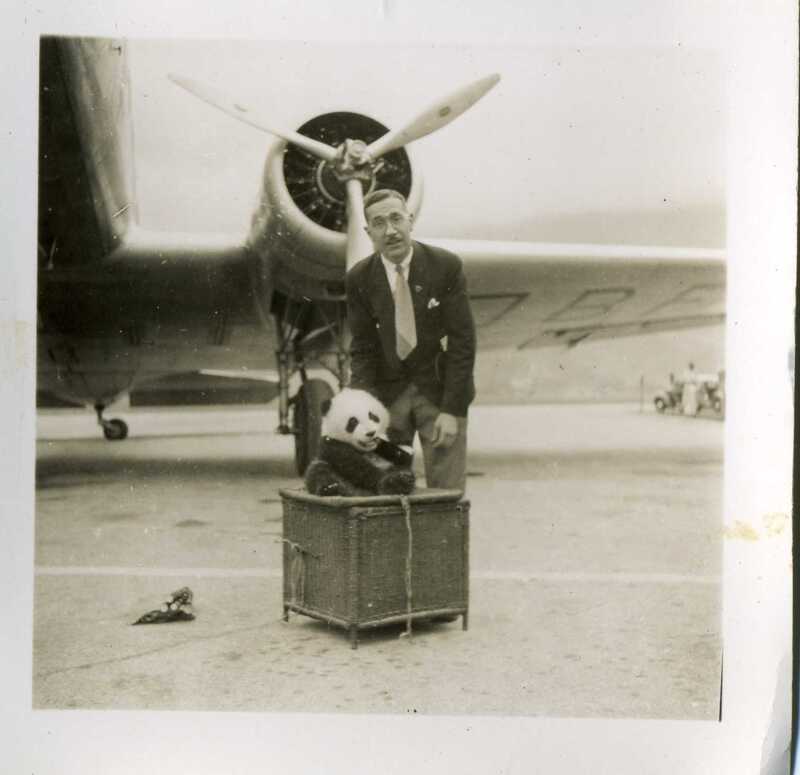
Another novel use of planes came during the “pandemonium” craze at WCUU, 1938-1941, during which as many as 14 live pandas were exported from Sichuan to American and British zoos. In 1938, Ruth Harkness (1938, 219) got round trip tickets in Shanghai on a “big Douglas,” probably a Douglas C-47, on her way into panda country in western Sichuan. With Sulin, the first baby panda to be captured and exported, Harkness flew triumphantly back to Shanghai. She was followed by several missionaries who exported baby pandas, including the famous Pandora and Pan, bound for the Bronx Zoo in the summer of 1938 and 1939, respectively. Albert Best (1939) who escorted Pan, wrote of the challenges of air travel with a baby panda in the West China Missionary News. In 1941, David Crockett Graham (1942) secured two panda cubs to replace Pandora and Pan, who had died in captivity. This pair were also flown from Chengdu to Chongqing and then on to Shanghai.

1941 Graham's Giant Panda Hunt
Click the link to read the story of Pandah and Pandee's capture and journey to the Bronx Zoo.
The Japanese invasion of Shanghai in November 1937 radically changed the role of planes in West China. Japanese occupation of eastern Chinese cities prompted Chiang Kaishek to establish his capital in Chongqing in October of 1938 (Rodriguez 2011). That same year, another airfield was built near Chengdu. The Shuangguisi Airbase, currently the Chengdu Shuangliu International Airport (成都双流国际机场), was built for small biplanes in the Republic of China Airforce to defend Chengdu. From this point forward, Chongqing, Chengdu and Kunming, Yunnan, became increasingly important in air transportation for mail and supplies, as well as for military and missionary passengers. By 1939, the dangers of war prevented missionaries from taking the Yangtze River route out of Sichuan, and flying out was a new but dangerous option.
When the Stockwells left for furlough in 1941, Esther and her son Foster flew from Chengdu to Chongqing, where they caught a flight to Hong Kong through Guilin, which was the capital of Guangxi Province at the time. They became friendly with the young American pilot who let Foster sit in the cockpit while flying over the spectacular mountain ranges below. In a chance encounter, Esther met the pilot’s father while on furlough in the US, and she was able to assuage his fears by telling of his robust health and spirit (Stockwell 1980, 103-4).
Because of the mortal perils of wartime travel, arriving safely in Sichuan was a source of satisfaction, if not an outright relief. During the war, the threat of Japanese bombers was ever present because the airplane route from the coast to Sichuan was over Japanese occupied China. As Roy Spooner explained, they took the flight direct from Chongqing to Hong Kong despite warnings not to:
Last September (1938) the Japanese shot down one of the planes on this run and we have not advised travel by this route. However, the planes were still flying and had not had another fatality. So rather than take the families down into Indo-China and then fly from Kwenming [Kunming], we took passage direct from Hongkong. This meant waiting as there was a long lineup. Further there was no regular service being maintained as planes flew only at the nighttime and at irregular intervals.
American missionary Frank Price (1943, 4) may have known a woman who was on the shot down plane. On a China National Aviation Corporation flight from Kunming to Chongqing, he met a stewardess whose parents had graduated from his parents’ school near Nanking. She had come to Sichuan with the migration of Ginling College and found a job with the airline. Three weeks after he met her, he learned that a flight she was on from Chongqing to Hong Kong had been forced to land by Japanese fighter planes and they machine-gunned everyone on it to death.
Allen-Stinson Burma Road Trip, 1938
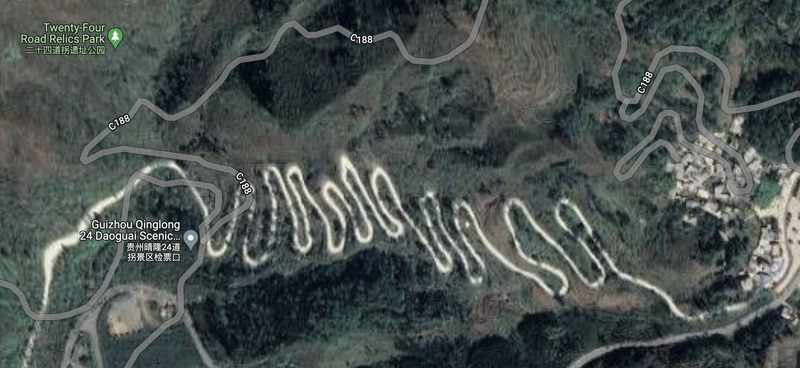
Click the link to read the story of Stewart Allen's and John Stinson's trip through Indo-China with notes on the flight taken by the women and children.
Even flights that arrived safely to their destinations could be unpleasant. As Marnie Copland (1980, 60) explained, the airplane cabins were not pressurized, which can cause passengers to experience oxygen deficiency symptoms such as headaches, dizziness, cognitive dysfunction and vision problems. Flying at low altitudes helped with air pressure, but exposed the plane to violent turbulence, causing many passengers to vomit. Marnie recalls that the smell of chocolate on her daughter’s breath made her and her husband “reach for our sick sacs.”
Frequently, missionary men were called upon to escort supplies over the arduous Burma Road, while women and children flew ahead, arriving weeks before them. In 1938, the Stinson and Allen families were separated this way, John Stinson and Stewart Allen were charged with Burma Road truck duty, while Isabelle Stinson, Win Allen and the three Allen children flew from Hong Kong to Chongqing. Both women “lost their breakfasts” when their plane flew through a severe storm. As Isabelle wrote in her diary, “We hit air pockets and fell, then rose again, and the lightning flashed and clouds were dark – we couldn’t see the earth for some time” (Stinson and Dougherty 2022, 13).
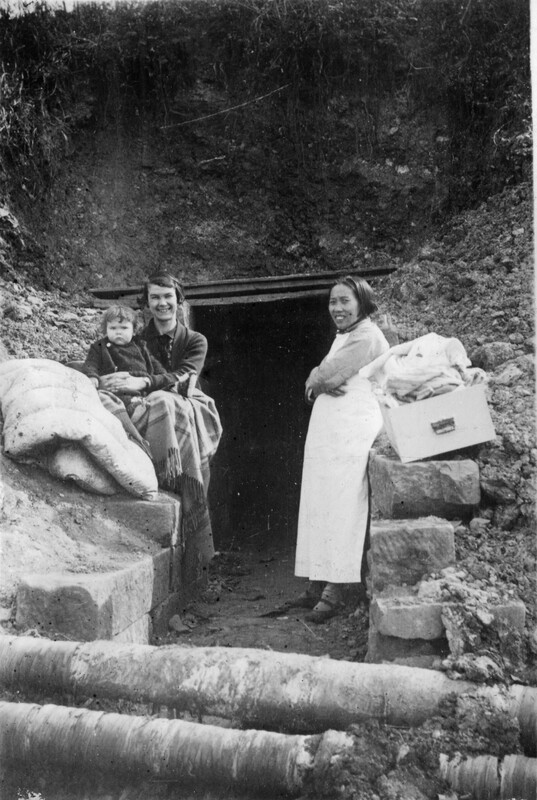
Bomb Shelter in Chengdu, 1940
Isabelle and David Stinson with Amah and supplies at mouth of bomb shelter.
When Roy Spooner and his family returned from furlough in 1939, they stayed in Hong Kong briefly before embarking on the next stage of the journey. Roy was to traverse the Burma Road with luggage and medical supplies. Kathleen Spooner, plus the three Spooner children, Mary Birtch and sixty-six pounds of luggage, went ahead of him, flying from Hong Kong to Chengdu by plane. Two nights before they left, Fred and Annie Reed and Jean Holt got on a flight at 2:30 AM. Having been told not to tell anyone of their imminent departure, Roy heard his eight-year-old son David Spooner telling the “other children that no one was to know [the missionaries] were going because the Japanese might come and bomb the plane” (UCCA 2013.028C/TR Spooner September 26, 1939). The Spooners’ plane also left at 2:30 in the morning to avoid Japanese detection.
By the late 1930s, Japanese bombers were also invading Sichuan. Many missionaries built air raid shelters near their homes on the WCUU campus and in many other cities in Sichuan. Margaret Simkin (1977, 199-200) described the first air raid in Chengdu in early June 1939. The first siren sounded at about 2:30 am as soon as Japanese planes crossed the Sichuan border. When a second siren sounded, she and her family retreated to their basement where they found other families already gathered. The all-clear signal came at 4:30 am, and then another alert took place between 5 and 6 am. They learned later that the Japanese planes were flying around so long because they had failed to locate Chengdu!
Some missionaries retreated to the mountains to escape the air raids. In 1939, Margaret Outerbridge (in Munro 1990, 49) was just laying down for an afternoon nap in Kiating when she,
… heard the low roar of airplanes and sound of heavy machine guns. Then the house shook with the fall of a not-too-distant bomb. In a flash, I was into the nearest piece of clothing and outside under a tree. Some three dozen Japanese bombers, high, high up, circled in the distance. They were firing at the beautiful Douglas passenger plane due in today at Chungking from Hong Kong. Later, people further up the mountain said it was thrilling to watch the Douglas, like some hunted bird dip, bank and dodge, as it flew over the “Gin Din” as though seeking to land. What we saw was dramatic enough for our household, in that we expect Gordon Campbell [a fellow missionary] is on board… It’s turned into a real adventure for him, first dodging Japanese bombs in Chungking and now this. Fortunately, the Douglas escaped.
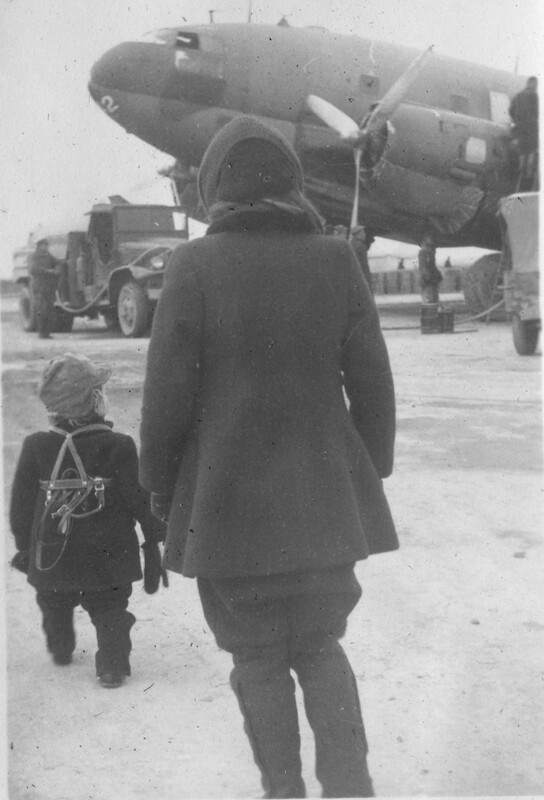
After WWII ended in August 1945, air routes and flight times returned to normal. When the Stinsons flew from Shanghai to Chongqing in 1947 they had a stopover in Hankow (modern-day Wuhan), which had been a familiar stop on the Yangtze River journey to Sichuan. Isabelle was already an old hand a flying, but now she had two small children of her own to manage on board. To keep track of little David, she had him strapped into a handy toddler harness.
Even after the war, flying was dangerous because the planes were in poor condition. Many had not been serviced since before the war. The Kitchen-Tonge family endured the most tragic of flight events. After disembarking the notorious Marine Lynx, Beatrice Kitchen, Muriel Tonge and her husband Walter Tonge were delayed in Shanghai waiting for a flight. With Muriel within three weeks of the due date of her baby, they were desperate to get to West China where hospital fees would be minimal. Finally, they obtained three tickets for a flight to Chongqing. However, Beatrice Kitchen exchanged hers with another woman who had a ticket for the next day. She convinced Beatrice that she must get to Chongqing that day to tend to a deathly ill patient.
When Muriel and Walton arrived in Chongqing, Muriel took the next flight to Chengdu, leaving Walton alone on the runway with no way to communicate with the Chinese who were swarming him looking to carry his luggage or him to the mission station. The next day, Muriel was enjoying a happy return to her childhood home and reunion with her father on the WCUU campus in Chengdu, while Walton was back on the Chongqing airfield awaiting Beatrice’s flight and a connecting flight that would take them both to Chengdu. It was not to be that way.
When Beatrice Kitchen flew from Shanghai to Chongqing in 1944, her plane’s engine caught fire. The pilot tried to land on a beach, but instead he crashed into a field. All the passengers died except one small infant who was clasped in Beatrice’s dead arms. Since planes did not keep passenger rosters, it took three days before she was identified and her death was confirmed (Foster 2008, 34).
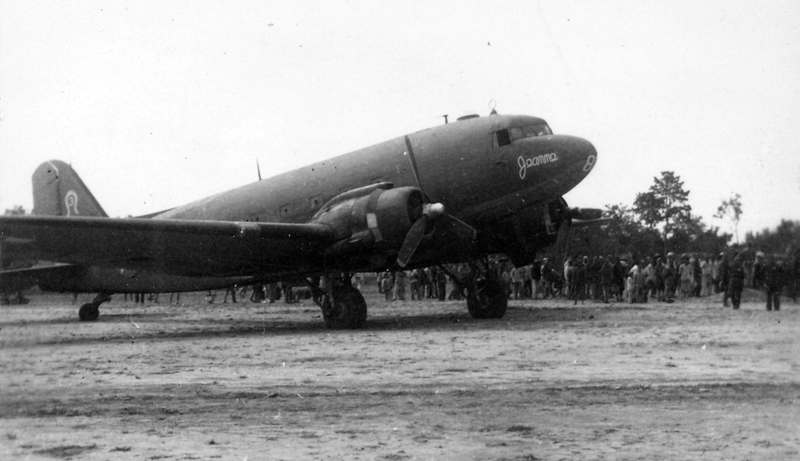
Douglas C-47 Skytrain at Liangshan Airbase
One of the planes that flew the route between Chongqing and Hong Kong during and after WWII.
Walton heard the workmen at the airstrip whispering in grim tones and soon learned that a plane had been lost. News arrived in small installments, so that it was several days before anyone could confirm that Beatrice had died in that crash. Walton was held up in Chongqing while the air service dealt with the disaster, while Muriel and her father were crushed with grief in Chengdu. Walton must have felt some trepidation about boarding a plane to take the last leg of his first missionary journey to Chengdu. Two weeks later, the Tonge’s baby daughter Leslie Irene was born, being the third generation of Kitchen females to live in China.
Wartime and postwar travel to West China was very different from the journeys by the first missionaries, and not only in the tragic end to the Kitchens’ journey. The new air and marine technologies – even the smelly and uncomfortable “missionary ship” - collapsed the time between embarking in San Francisco or Vancouver and stepping into a new home in Chengdu, or Penghsien. By the end of the 1940s, missionaries were arriving more quickly, with less time to absorb the novel sights and sounds of China, but probably with greater foreknowledge of their destination, thanks to more rapid communication between the mission field and the sending communities.