Appendix: The West China Cohort: A Deep Dive into Data
This virtual exhibit is about a cohort of American and Canadian youth who took the pledge to do missionary work and were appointed by their various mission boards to work in Sichuan, China. They were part of a youth movement that swept across North America between about 1890 and the late 1920s in the United States, and into the 1950s or later in Canada. This chapter looks at the characteristics of the cohort of West China missionaries who were participants in this movement and the other traits they shared in common.
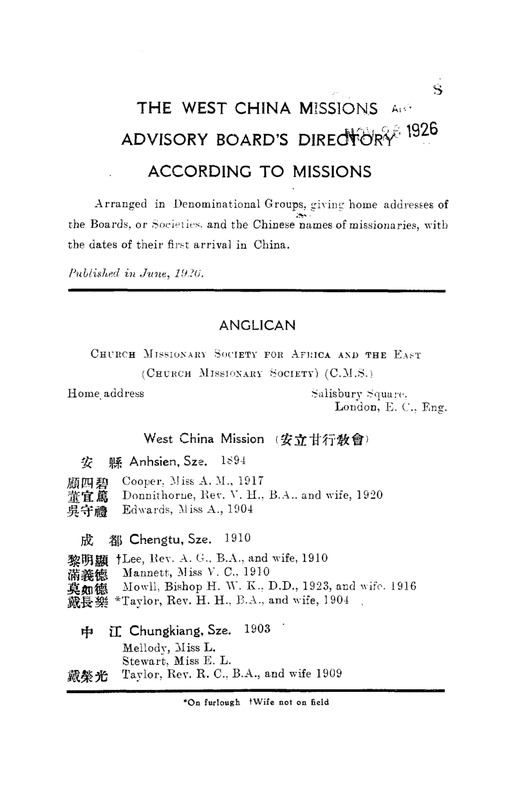
The West China Missions Advisory Board’s Directory 1926, According to Missions
Click here to see the list of Protestant missionaries in West China in 1926.
Statistics for the bar charts in this section were taken from a list of missionaries in West China assembled by the West China Missions Advisory Board, and published in the West China Missionary News, in 1926. This year was the heyday of mission work in West China, after three decades of growth, and before the Nationalist Revolution of 1927 removed foreigners’ extraterritorial privileges and the Guomindang took control of the central government. For an analysis of missionaries in the West China field over the decades of their occupation, see Analysis of West China Missions Personnel Trends, 1916-1941.
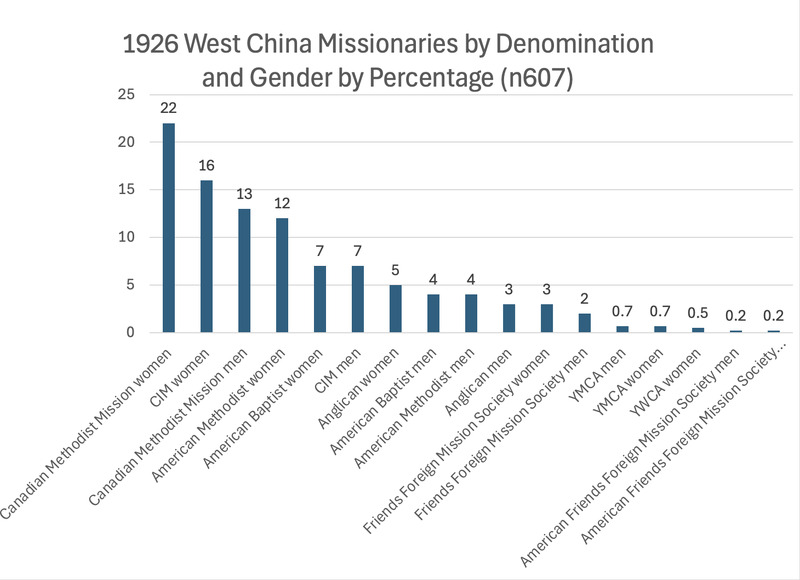
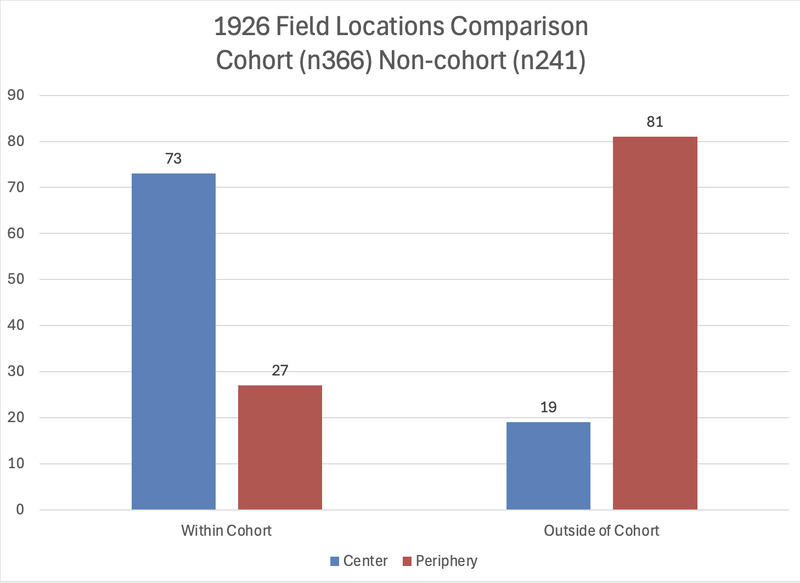
Whereas few members of the cohort will share all factors in common, most of them will share a significant number of common factors. Before discussing the defining traits of the cohort, its general outlines can be seen in two factors: 1. The Protestant denominations that are members; 2. The location of their mission fields within West China. It should also be noted here that both within and beyond the cohort, women dominated the mission field.
The Protestant denominations included in the cohort of West China missionaries are the American Methodists (Board of Foreign Missions of the Methodist Episcopal Church – BFMMEC or MEM for short), Northern Baptists (American Baptist Foreign Mission Society - ABFMS), and Canadian Methodists (Canadian Methodist Mission – CMM), as well as the United Church of Canada (United Church of Canada Mission – UCCM) after it was formed from the Canadian Methodist, Presbyterian and Congregationalist churches in 1926. The American Friends and YM/WCA also fit into the cohort, although there were only a few of them in the West China field at any given time. All these groups had headquarters and church memberships in North America. The North American Presbyterians and Congregationalists also had missions in China, but none of these were in West China. All these groups subscribed to some form of socially conscious theology, most prominently the social gospel.
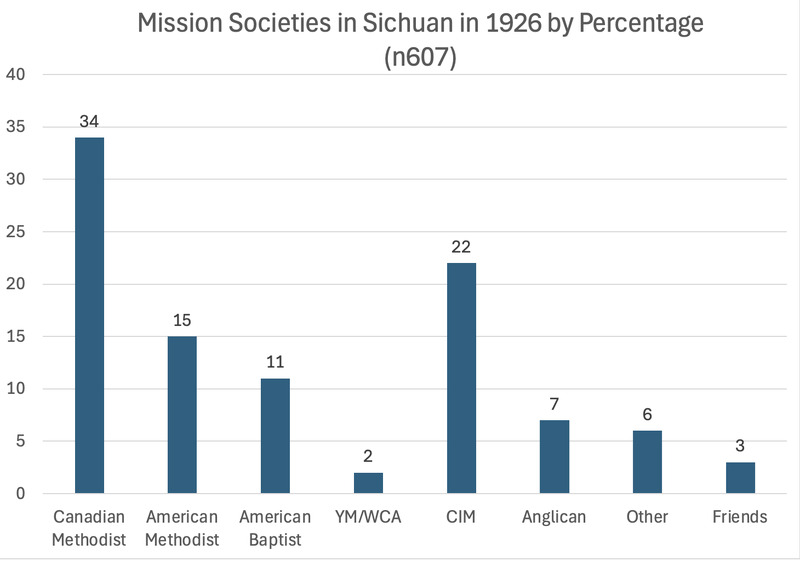
In contrast, Protestant missionaries in the West China field who did not fit within the cohort were those from the China Inland Mission (CIM), the British Friends (Friends Foreign Mission Association – FFMA), the British Anglicans (Church Mission Society – CMS), and the Seventh Day Adventists. All but the latter were British. Although these groups were stationed in West China, participated in its missionary social life and published pieces in the West China Missionary News, their demographics and paths to missionary work were very different from those of the cohort under study. The theology of these groups tended to be on the conservative side, except that of the British Friends, who held some theological and political perspectives in common with the cohort.
As the bar and pie charts show [1926 Denominations of all Missionaries in Sichuan], Canadian and American Methodists combined accounted for almost half of the missionaries stationed in West China in 1926. The second largest group, the CIM, drew members from England, Canada, Australia and the United States. These missionaries were of a conservative bent theologically. Falling far behind at third in place, the American Baptists were closely aligned with the Methodists, theologically, socially and politically. It might also be noted that these three missions, American and Canadian Methodists and American Baptists, were in the front lines of founding and building the West China Union University, whose campus was the center of missionary life for the whole province.
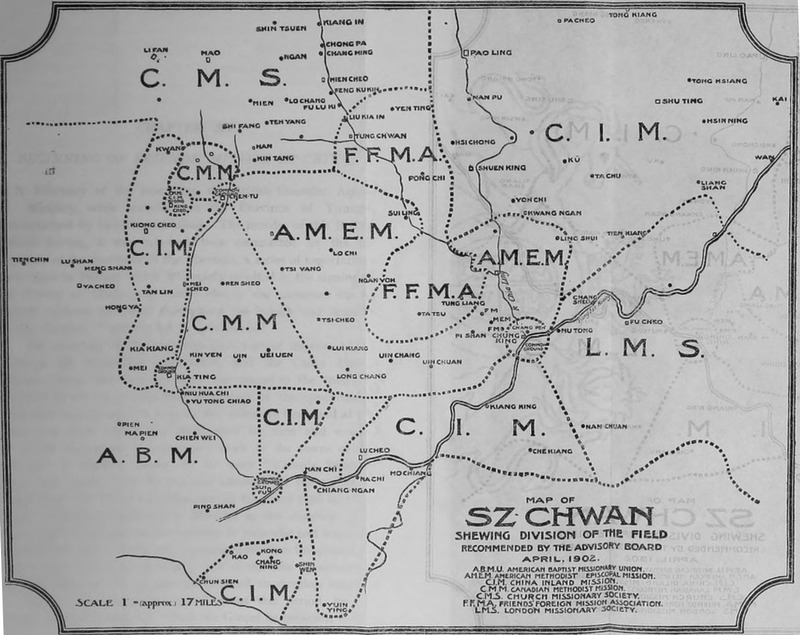
Also, as seen in the bar chart (1926 Field Locations of all Missionaries in Sichuan], although the CIM was the first to open the West China mission field in 1877, by the turn of the twentieth century, they had mostly abandoned to other missions the cities of the Chengdu Plain and the Min River corridor, as well as the river valleys above Chongqing and downstream on the Yangzi River. They sent their missionaries instead to remote towns and villages in the western mountains of Sichuan and Tibet, as well as to the provinces of Yunnan and Guizhou. Regarding the Yangzi River, the CMM took over all the London Missionary Society’s field in 1910.
While Protestant denomination and geographic location of missions define the denominational and geographic parameters of the cohort, they do not explain why members of these denominations may be treated as a cohort. Looking at the traits that mold individuals into particular life courses, the defining factors of this cohort follow the life trajectory of missionaries from birth to taking up a position as a missionary. These are: 1. Place of birth; 2. Socioeconomic background; 3. Higher education; and 4. Membership in or affiliation with parachurch youth groups such as the YM/WCA, Student Christian Movement, Student Forward Movement.
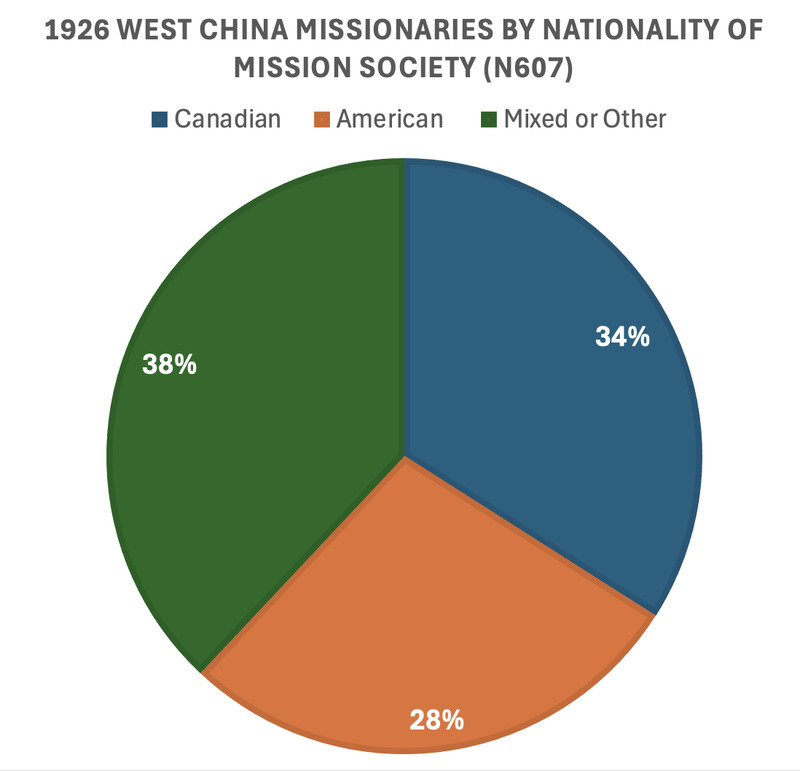
Genealogical research on members of the cohort reveal distinct patterns in their places of birth. The bar chart representing the missionaries’ countries of birth shows that the North American countries of the cohort’s Protestant denominations dominate the West China mission field. Notably, the majority are from Canada, confirming the dominant role of the CMM in West China. A significant number were born in West China and other parts of China, showing a trend towards multigenerational missionary families. Only 26 and 15 percent of missionaries were born in the United States or England and its colonies (apart from Canada), respectively. However, when considering the national affiliations of the home mission societies, the numbers appear more even because there were missionaries born in different countries than those that supported them as missionaries as, for example, those born in China.
Breaking down the North American birth places by region, an overwhelming majority of West China missionaries were born in the Canadian Midwest (i.e. Ontario), followed by the American Midwest, and then the Canadian and American northeast. Very few missionaries were born in any other region of Canada or the USA [Percentage of North American Missionary Birth Places by Region]. Interactive google maps of individual birth places in Canada and the United States show these trends graphically, with the Canadian contingent concentrated tightly in Ontario, and the American missionaries less tightly clustered, but following the same trends .
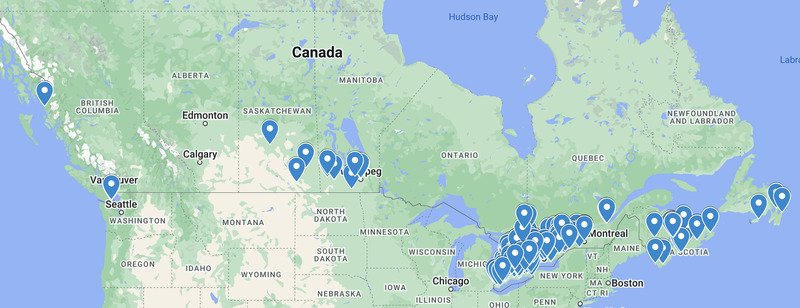
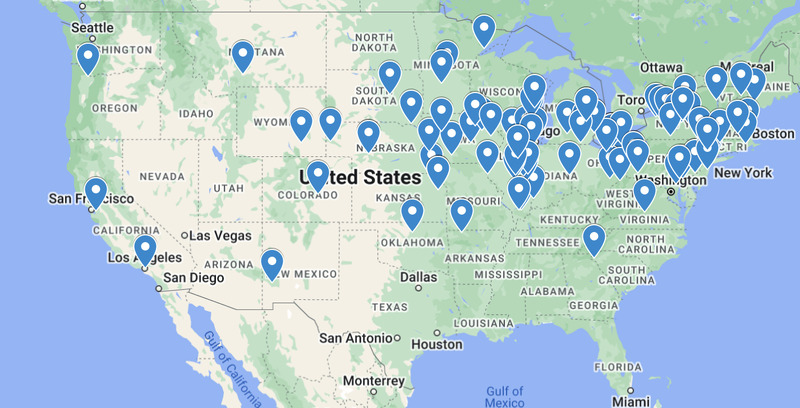
Analysis of the missionaries’ birthplace population size for those whose exact place of birth is known sheds light on the regional trends by providing a glimpse into their socioeconomic backgrounds. About two thirds of the missionaries come from communities and towns with a population lower than 50,000, with the majority of these less than 5,000. This shows that a majority of the cohort members come from farming communities of in the middle regions of North America.
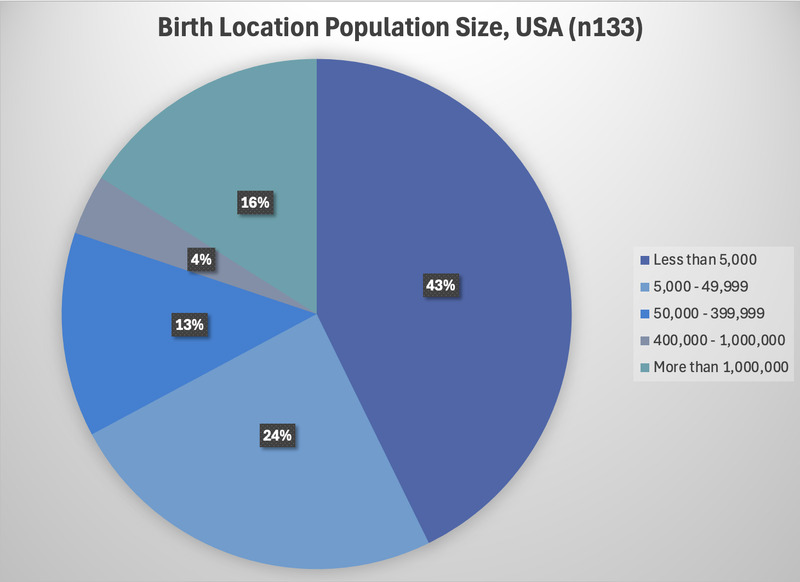
These are communities in which social life evolves around the church, and many of the West China missionaries have preachers and pastors among their close family members. Moreover, many children of farming families in these regions would have been introduced to mission work through the Epworth League, a youth organization of the Methodist Church that gathered funds and other support for overseas missions from children from ten to thirty-four years of age (1).
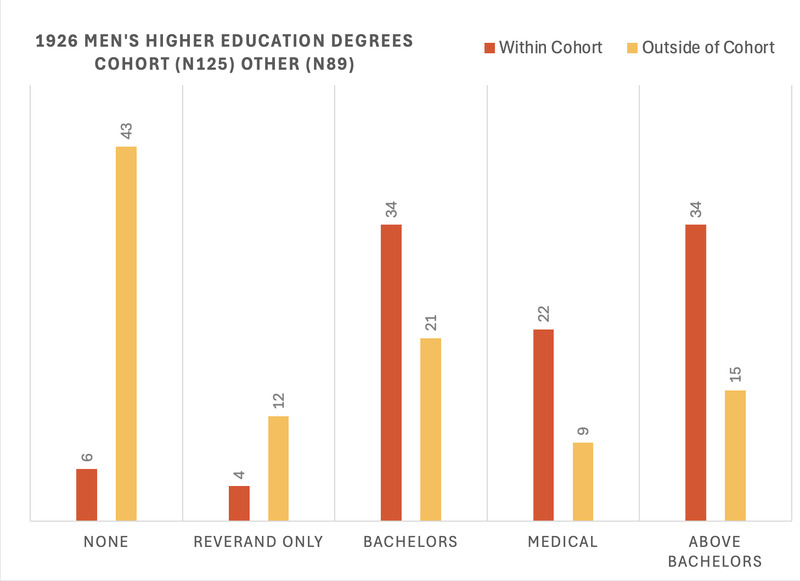
Family farms were not large enough to support all the children who were born on them, not to mention these children’s families in new generations. Therefore, those children who did not inherit the family farm sought avenues out of the farming life, which often included moving to the nearest city to attend university. The cohort has an extraordinarily high rate of university graduates for the time for both men and women, which marks it as a defining characteristic of the cohort. In 1920, only 5.7% of the population had a Bachelor’s degree or higher (3). In contrast, for the missionary men, only six male members of the cohort had no degree and another four had only a Reverand degree, compared to forty-three members of the non-cohort with no degree and twelve with on the Reverand degree.
Among those West China missionary men who had degrees, cohort members outnumber non-cohort members in every category (Bachelors, Medical and Above Bachelors). Fully 90% of cohort men had higher education degrees, compared to only 45% of non-cohort men. Conversely, 55% of non-cohort men have either no degree or Reverand only, while only 10% of cohort men fall into these categories.
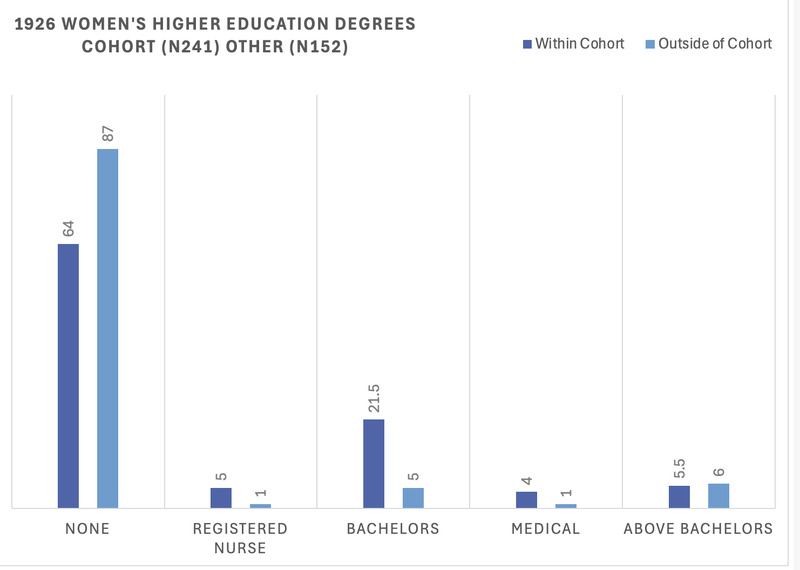
Garnering the numbers of female missionaries with degrees is complicated by the fact that not all stations reported the educational achievements of their female members, particularly missionary wives. Additionally, many women elected to enroll in nursing or missionary training programs after a year or two in college, which were analogous to community college certificates (see Ch 3-3 Training for Missionary Women). These were not recorded in the personnel statistics. Therefore, the numbers in the women’s education bar charts are skewed to the low end.
While both cohort and non-cohort women without degrees outnumbered those with degrees, the numbers of missionary women with degrees – 36% of cohort women and 13% of non-cohort women – was still significantly higher than that of the general population. In the 1920 census, at 18 years of age (roughly college age), about 22% of men and 25% of women were attending school. At age 20, these numbers had dropped to 8% of women and 10% of men (4). Among those who had degrees, 69 percent were in the cohort group, while only 31 percent were non-cohort members, with a predominance of married women having Bachelor’s degrees.
The matter of higher education is also significant for the final determining factor, which is membership in funnel youth organizations such as the Epworth League, the YM/WCA, the Student Christian Movement, the Young People’s Forward Movement and the Student Volunteer Movement. Although no statistics are available, many anecdotal stories mention specifically the path to missionary work beginning at a meeting of one of these groups, followed by signing a pledge card, becoming convinced of a calling to service, and then eventually signing up for missionary work, possibly after completing college or other training. It is these pathways, too complex to outline here, that served as the most salient factor of cohort membership because it served as a common initiatory experience for almost all members of the cohort.
A picture emerges of a cohort of youth who had been introduced to foreign missions as children through the Epworth League and other church youth organizations, who left family farms to attend university, where they joined other Christian youth organizations, met other youth interested in mission, and eventually pledged to become missionaries through these groups. The impact of the Epworth League in funneling youth toward mission is evident in the higher numbers of Methodists among the West China missionaries. However, once in university, youth of other Protestant denominations joined ecumenical organizations such as the YM/WCA, which likewise focused on missions. Thereby, this cohort was formed through the common experiences of their youth leading up to their lives as missionaries.
(1) J. Warren Smith. 1981. Youth Ministry in American Methodism’s Mission. Methodist History 19(4): 224-230.
(2) National Center for Education Statistics (NCES). 2013. Table 104.20. Percentage of persons 25 to 29 years old with selected levels of educational attainment, by race/ethnicity and sex: Selected years, 1920 through 2013 (https://nces.ed.gov/programs/digest/d13/tables/dt13_104.20.aspm) (content no longer available)
(3) United States Census Bureau. 1924. An Analysis of School Attendance in the United States and in the Several States, with a Discussion of the Factors Involved, Charts 1 and 2. (https://www.census.gov/library/publications/1924/dec/monograph-5.html)