American Methodist Episcopal West China Missionary Attrition
Item
-
Identifier
-
DS0021
-
Description
-
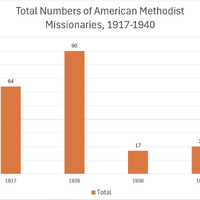
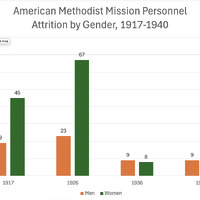
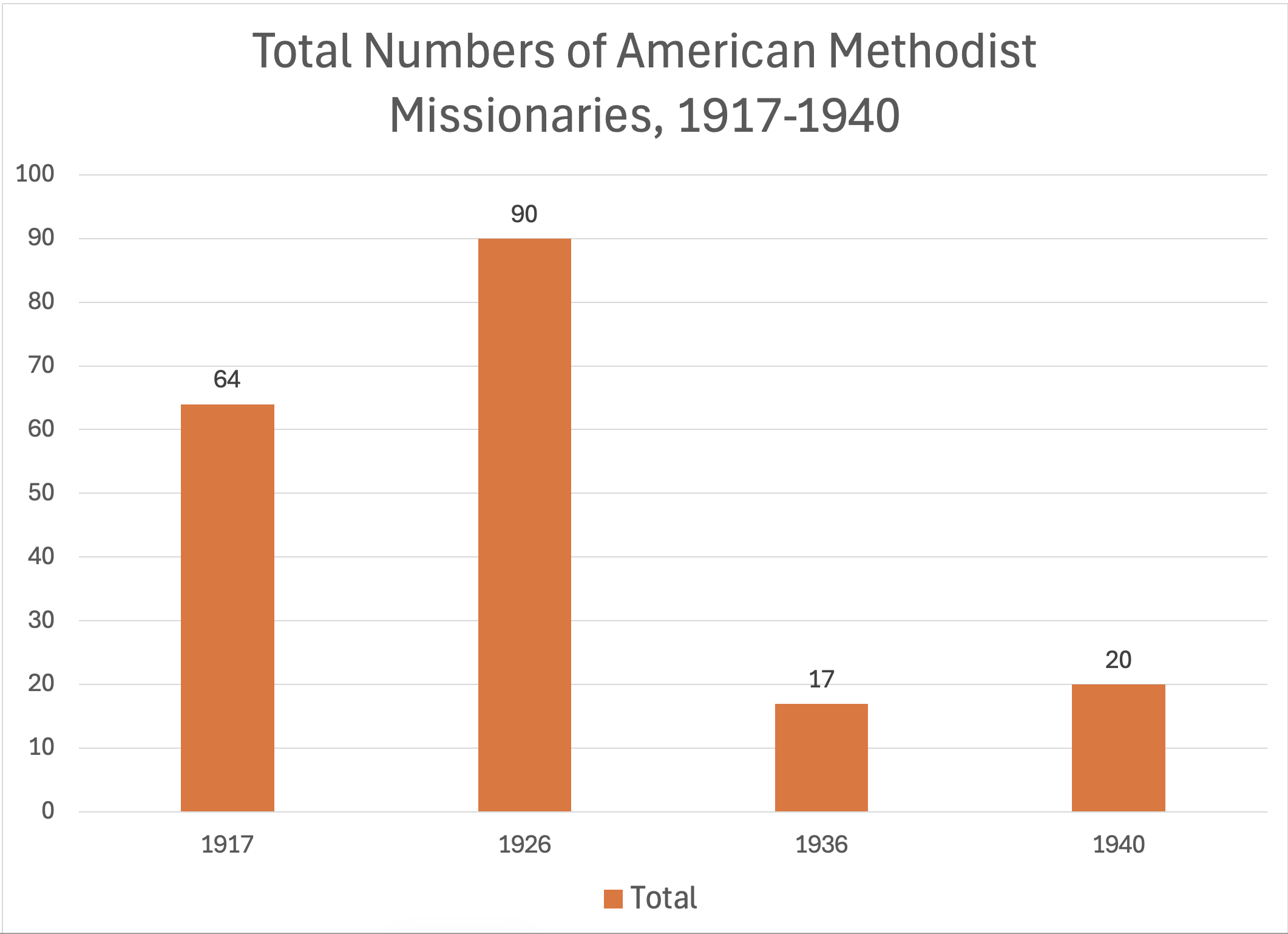
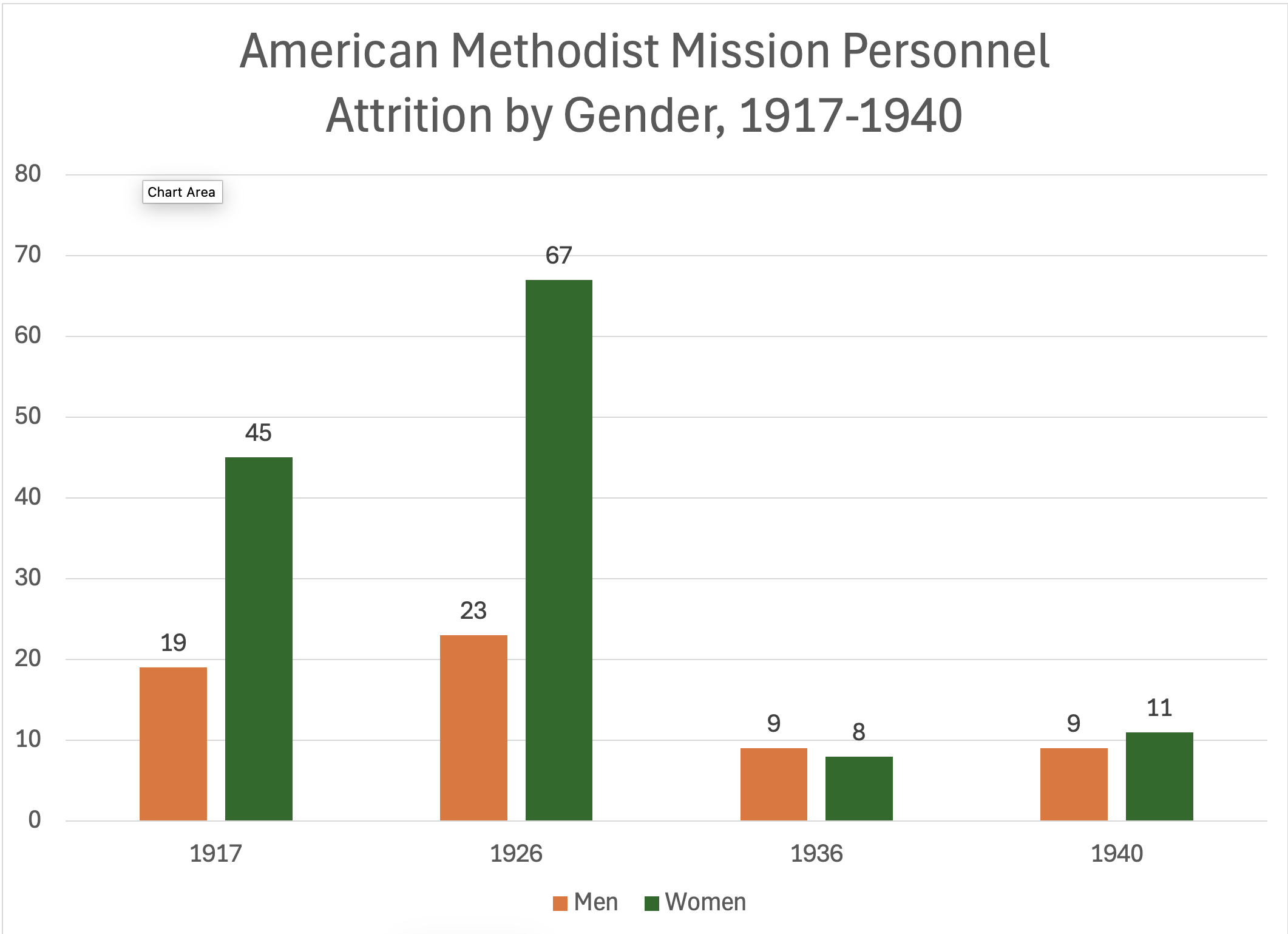
Bar charts representing the numbers of American Methodist Episcopal missionaries in Sichuan, in total and broken down by gender, as listed in the directories of Protestant missionaries in China for 1917, 1936 and 1940, as well as for West China in 1926.
See all items with this value
-
Commentary
-
The Methodist Episcopal missions in West China were divided into two conferences, Chengdu and Chongqing, each including one or more subdistricts (Chengdu Conference = Chengdu and Tzechow [Zizhong] districts; Chongqing Conference = Chongqing, Hochow [Hechuan], Jungchang [?] and Suining districts). Within each of these districts, missionary work in the cities evolved around schools and hospitals, while evangelism and primary schools were the focus in the rural areas.
The chart shows two major trends: 1. Increasing numbers of missionaries between 1917 and 1926, particularly women, followed by a severe drop by 1936 that continued low in 1940; and 2. Substantially higher numbers of women in 1917 and 1926, but almost equal numbers of women and men in 1936 and 1940.
Like the American Baptists, the Methodist Episcopal Missions (MEM) suffered financial challenges in the 1920s that grew more severe toward the end of the decade and continued into the 1930s and 1940s. Following the “Exodus” of 1927, when almost all the missionaries evacuated to the coast or beyond, many of the American Methodists did not return to the field. In 1929, The annual report for the Chengdu Conference noted that while the “decreased appropriation threatened disaster,” the budget was saved from additional debt by an increase in the exchange rate on gold to silver. Salaries had to be raised due to rapid inflation, but they still did not meet the spending power of previous years. The low salaries caused the loss of two Chinese preachers.[1]
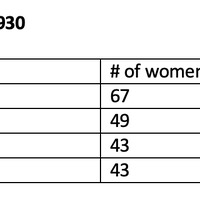
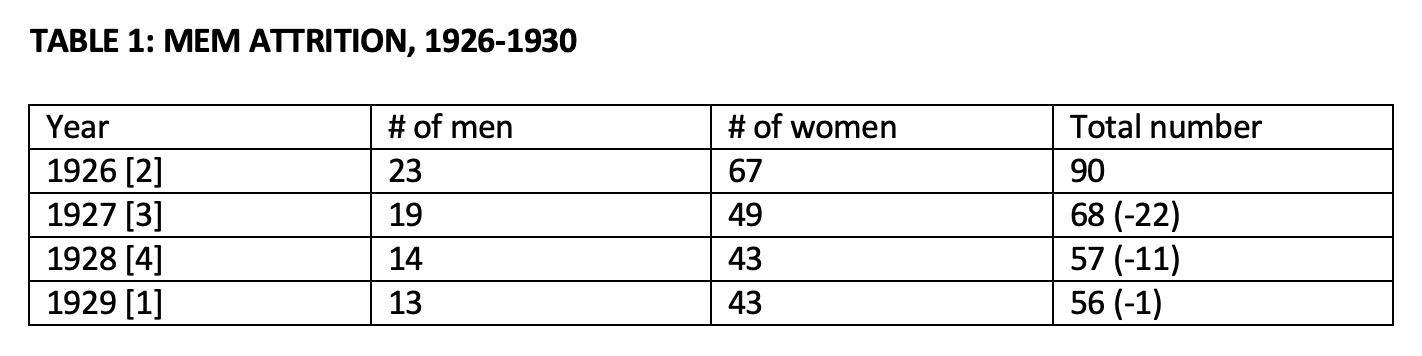
As seen in Table 1, missionaries listed in the annual reports for 1926 [2], 1927 [3], 1928 [4] and 1929 [1] show an immediate drop in personnel after the evacuation, continuing rapid attrition the next year, and then a levelling off. We can also see from these numbers that the highest attrition rate was among the women, mostly single women of the MEM’s Women’s Foreign Mission Society. Many of these had left their posts in the smaller cities of Suining (1926 – 8; 1928 - 3) and Tzechow [Zizhong] (1926 - 8; 1928 – 4), and continued to have addresses in Beijing, Shanghai and in the United States, suggesting that they had not returned to Sichuan although they remained on the roster. By 1930, the West China MEM was down to 20 missionaries, where it remained give or take one or two through 1940.[5]
It should be noted that the West China Chengdu and Chongqing Conferences were among the smallest of the MEM’s extensive network of missions throughout China and the world. These other missions’ extensive demands for support competed with those of West China, to the detriment of the latter.
On the other hand, a glance through the personnel listings of the West China Conference Annual Report for 1938 shows but a smattering of foreign missionaries compared with the large number of Chinese in leadership and lay positions.[6] It appears that the MEM withdrew foreign missionaries as they were replaced with Chinese counterparts, many of them graduates of the West China Union University.[6]
It is difficult to determine why so many women left the MEM, in part because the MEM’s West China Women’s Missionary Society annual reports are not available online, if they exist at all. Emily Gentry, wife of MEM medical missionary Bill Gentry, described Chongqing as “greatly depleted in foreign mission (and business) families” when she returned there from Shanghai in 1928. She doesn’t explain why except to say that the Peats had been reassigned to Singapore. Similarly, she notes that the “big WFMS house in the Methodist compound was temporarily empty,” and there were only four women of that society left in town. Two of these were assigned to a girls’ school in the country and the other two to the Women’s Hospital in the city. The mission board in New York decided to close this 65-bed hospital, however, due to its burning to the ground and a costly legal suite about a patient who had committed suicide. [7] I suspect similar closure decisions came from the New York mission headquarters.
See all items with this value
-
Creator
-
Cory Willmott
-
Date Created
-
2026-05-05
-
Publisher
-
SIUE
-
Record Date
-
2026-05-15
-
Contributor
-
Cory Willmott
-
Type
-
Dataset
- Resource class
- Dataset
 The West China Missions Advisory Board’s Directory 1926, According to Missions